
Advancing Clinician Expertise in Recurrent and Metastatic Head and Neck Cancer
Expert Perspectives · Lyn Brook · 2024-10-16
i3 Health recently provided an educational activity that has challenged clinicians’ knowledge proficiency in recurrent and metastatic head and neck squamous cell carcinoma (HNSCC).
Head and neck cancers represent a heterogeneous group of tumors that originate in the lip/oral cavity, hypopharynx, oropharynx, nasopharynx, and larynx. An estimated 67,000 new cases are diagnosed in the United States annually, and 15,000 people die of the disease. Approximately 90% of cases are classified as HNSCC. Treatment of HNSCC is complicated by numerous factors, including differing therapeutic strategies based on tumor location and stage, human papillomavirus (HPV) status, the need to preserve surrounding organs and tissues, and impacts on quality of life. Remaining up to date on emerging treatment options and management strategies for HNSCC is vital.
To address the knowledge gaps experienced by clinicians regarding HNSCC, i3 Health curated a continuing medical education (CME)/nursing continuing professional development (NCPD)–accredited live meeting series and online video viewpoint strategy session. A total of 10 live visiting faculty meetings were held between May 2023 and May 2024, with an accompanying online video viewpoint strategy session made available on i3 Health’s website. Leading this activity was an expert in the field of HNSCC, Assuntina G. Sacco, MD, Associate Professor of Internal Medicine in the Division of Hematology-Oncology, Co-Director of the Hanna and Mark Gleiberman Head and Neck Cancer Center, and Disease Team Leader of Head and Neck at UC San Diego Moores Cancer Center.
Between the live meetings and the online activity, a total of 1,562 learners engaged with the content, and 764 completed the activity for credit. Most participants were physicians and registered nurses, followed by nurse practitioners, physician assistants, and those who chose “other” as their profession.
The baseline data collected revealed knowledge gaps in the following areas:
- Distinguishing histopathological, molecular, and clinical biomarkers that can inform prognosis and management of HNSCC
- Incorporating emerging efficacy and safety data on novel immune checkpoint inhibitors into personalized care plans for patients with advanced recurrent/metastatic HNSCC
- Applying strategies to prevent and mitigate immune-mediated adverse events
- Evaluating supportive care measures that can help optimize survivorship care in patients who have received treatment for advanced recurrent/metastatic HNSCC
Participants were given a matching pretest and posttest at the beginning and end of the activity, respectively: 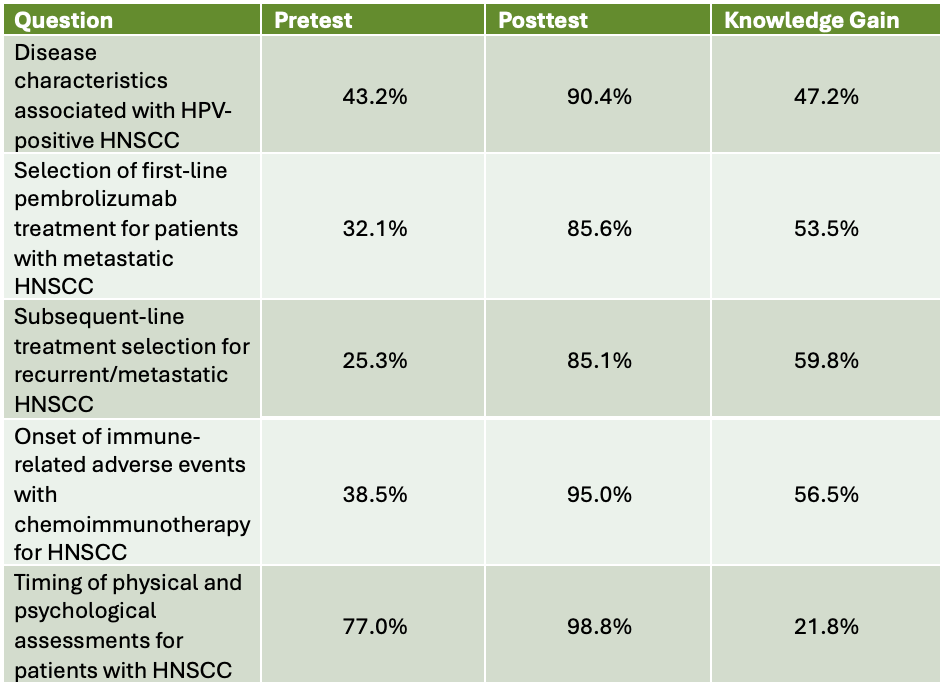
Upon completion of the activity, 91% of participants reported that they felt more confident in treating their patients with HNSCC, and 90% felt that the material presented would be used to improve the outcomes of their patients.
The data revealed by the posttest assessment affirm the effectiveness of online educational content pertaining to the topic of recurrent and metastatic HNSCC. Based on these data, i3 Health has determined that the multidisciplinary team may benefit from CME/NCPD activities that provide HNSCC education on the following:
- Biomarkers to inform prognosis and influence treatment selection
- Recent clinical trial findings on efficacy and safety of emerging therapies
- Strategies to prevent and mitigate adverse events
- Supportive care measures to optimize survivorship
Resources
i3 Health (2024). Recurrent and metastatic HNSCC: New insights and real-world evidence for improved patient outcomes: activity outcomes report. Data on file.