
The AI Co-Scientist: A New Paradigm for Discovery in Oncology?
Expert Perspectives · Waqas Haque, MD, MPH · 2025-10-14
In this edition of The Way Ahead: The Convergence of Technology and Cancer Care, Waqas Haque, MD, MPH, second-year Hematology/Oncology Fellow at the University of Chicago, examines the rise of the “AI co-scientist”—a multi-agent system that proposes, prioritizes, and stress-tests scientific ideas. Dr. Haque highlights early evidence from Google’s recent work on hypothesis tournaments, surveys the emerging landscape of AI co-scientist initiatives, and outlines a pragmatic path from in silico prioritization to real-world validation—forging a faster, more focused pipeline from question to clinic.
The AI Co-Scientist
As a second-year fellow in the midst of a research year, I often find myself at the intersection of established clinical pathways and the tantalizing frontier of new research. We are trained to be rigorous investigators, yet the pace of discovery can feel frustratingly slow when facing a patient with a rare mutation or a refractory disease. While developing individually tailored drugs is not yet possible, what if we could fundamentally accelerate the scientific method itself?
On February 19, 2025, a paper from a group of Google researchers introduced a concept that sounds like science fiction but is rapidly becoming a reality: the AI co-scientist. In essence, this is an AI system designed to augment the entire scientific process, from generating novel hypotheses to ranking them by different parameters (including novelty and parsimony) to suggesting the experiments needed to validate them.
A Lab Full of Agents
Imagine AI not as a single tool, but as a team of specialized agents, like members of a research lab.
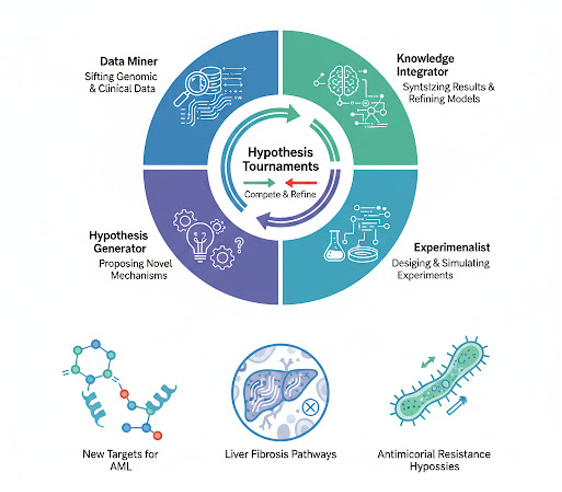
One agent might be an expert “data miner,” sifting through terabytes of genomic, proteomic, and clinical trial data to find previously unseen correlations. Another could be a “hypothesis generator,” proposing novel mechanisms of drug resistance. A third could be an “experimentalist,” designing the most efficient cell-line or mouse models to test these hypotheses.
To ensure only the most promising ideas move forward, these AI agents can engage in “tournaments.” In this framework, different AI models compete to generate the most plausible and testable hypotheses from a given dataset. This internal competition refines ideas, discards weaker concepts, and ensures that the final output presented to a human researcher is the worthy of investigation.
The initial research in Google’s paper highlights three compelling examples of this approach in action:
- New Targets for AML: Identifying novel protein targets for treating acute myeloid leukemia.
- Liver Fibrosis: Discovering new biological pathways involved in liver fibrosis.
- Antimicrobial Resistance: Generating credible hypotheses for the mechanisms behind antibiotic resistance.
From Sci-Fi to Lab Bench: A Reality Check
While the potential is enormous, we are a long way from true in silico medicine. For example, predicting a drug’s ADME (absorption, distribution, metabolism, and excretion) properties remains a huge challenge for computational models. We still need to test drugs in mice and monkeys before they can ever be considered for a human patient.
But perhaps the next question we should be asking is different. Instead of AI designing drugs from scratch, what if it could perfect the process of discovering what existing drugs can do?
The Power of Drug Repurposing
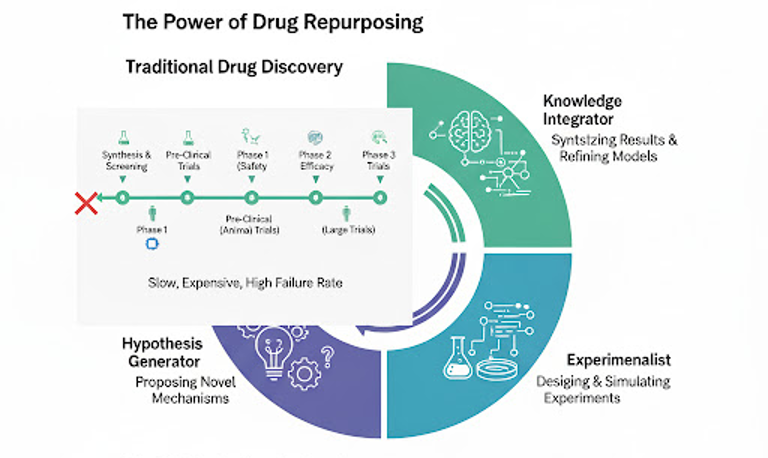
This is where I believe AI can have a more immediate impact. Drug repurposing—finding new uses for existing, approved drugs—is one of the most promising avenues in pharmacology. Think of thalidomide, the infamous drug leading to limb defects in newborns in the 1960s, that is now (in addition to cousin medications such as lenalidomide) used for treating multiple myeloma. The advantages are massive: these drugs often have extensive safety data from large human studies, their pharmacokinetics are well understood, and they are typically cheaper than developing a novel compound from the ground up.
A Case Study in NSCLC: Finding Old Drugs for New Problems
The real value of an AI co-scientist may lie where market incentives fail. In non–small cell lung cancer (NSCLC), we have incredible targeted therapies for common mutations like EGFR exon 19 deletions. But what about a patient with a rare HER2 mutation or a complex resistance profile? The small patient population makes it financially challenging for pharmaceutical companies to develop a brand-new drug for them.
This is a perfect job for the AI co-scientist. It can screen thousands of approved drugs, from chemotherapy agents to diabetes medications like metformin, against the specific structural protein data of a rare mutation. By predicting binding affinities and downstream effects, it can generate a short list of high-potential candidates for repurposing. We know that drugs such as propranolol, telmisartan, and metformin have been thought to have antitumor activity in NSCLC. This doesn’t replace the need for clinical trials, but it dramatically narrows the search space, saving precious time and resources and offering hope where none existed.
Ultimately, the AI co-scientist is not here to replace the oncologist or the researcher. It’s simply a new, powerful collaborator that can help us navigate the overwhelming complexity of biology, find needles in the haystack of data, and accelerate the journey from a scientific question to a life-saving therapy.
The AI Co-Scientist Landscape Today
Here’s a look at some of the prominent initiatives and groups developing similar AI co-scientist capabilities:
Initiative/Group | Key Focus | Status/Latest Update (2025) |
Google’s | General scientific discovery engine, hypothesis generation | Published paper (Feb 2025), internal development |
ToolUniverse | Ecosystem for creating AI scientist systems from any open or closed large language model | Available online |
OpenAI’s “DeepResearch” | Single-agent system for deep, multi-step reasoning for novel idea discovery | Introduced on February 2, 2025 |
Argonne National Laboratory’s “Scientia” | Building on Google’s co-scientist approach for protein engineering and design workflows, at the home of one of the world’s fastest supercomputers | Presented at a meeting in July 2025 |
The question is no longer whether AI will transform how we do science, but how quickly we can integrate these tools into our labs and clinics. For patients with rare mutations and limited options, that timeline matters more than ever.
About Dr. Haque
Waqas Haque, MD, MPH, is a second-year Hematology/Oncology Fellow at the University of Chicago. He recently completed his Internal Medicine Residency at New York University (NYU) in a Clinical Investigator Track. Dr. Haque has balanced his patient care work with a variety of research projects. During his fellowship training at the University of Chicago, he plans to further his work in innovative clinical trial design, value-based care delivery to cancer patients, and clinical investigation.