AI-Discovered Drugs Are Reaching the Clinic, But Are They Reaching Patients?
Expert Perspectives
By Waqas Haque, MD, MPH
Published
Artificial intelligence (AI) is now producing drugs that reach human trials at a steady pace, but very few have gotten past phase 2. That is the key finding of our new paper in Cancer Treatment Reviews: "Artificial Intelligence-Enabled Drug Discovery: A Growing But Largely Early-Stage Clinical Pipeline."
Every month brings another announcement that an AI platform has "discovered" a new drug candidate. One key moment was the use of AlphaFold—an AI-designed platform by Google Deep Mind that predicts protein folding—that compressed the early-stage discovery timeline to merely a few weeks for a small-molecule inhibitor for an idiopathic pulmonary fibrosis drug. As an oncologist, I kept running into the same question: how many of these molecules are actually in patients, and how far along are they?
We identified 129 AI-enabled therapeutic assets from 69 companies that had entered at least one interventional human trial through March 1, 2026. More than half (74 assets, 57.3%) are in oncology. The pipeline is real and growing fast, but it is young: only 24 assets (18.9%) have completed phase 2, and just five have entered or completed phase 3.
How We Built the Dataset
The hardest part of this study was deciding what counts as "AI-discovered." There is no standard taxonomy, and companies have every incentive to label a program as AI-driven. We used a strict, asset-level definition: a drug qualified if public evidence showed that AI meaningfully contributed to target identification, candidate generation, or lead optimization for that specific molecule.
We excluded assets when AI appeared only as a general company tagline, or when it was used only downstream—for example, in patient recruitment, site selection, or trial design. Three independent reviewers screened candidates using company pipelines, press releases, trial registries, Citeline Pharmaprojects/Trialtrove, and ClinicalTrials.gov, with a senior reviewer adjudicating disagreements.
To estimate success rates, we used the path-by-path method of Wong et al (2019), which follows each program's full development path instead of multiplying phase-transition probabilities. It gives more conservative estimates when much of a pipeline is still early. Company-level data on funding, headcount, and timelines came from PitchBook plus public disclosures.
What We Found
The pipeline took off after 2019. AI-enabled drugs entering the clinic trickled in until the late 2010s. Annual entries then climbed to a peak of 25 in 2023, and the cumulative count passed 100 by the end of 2025.
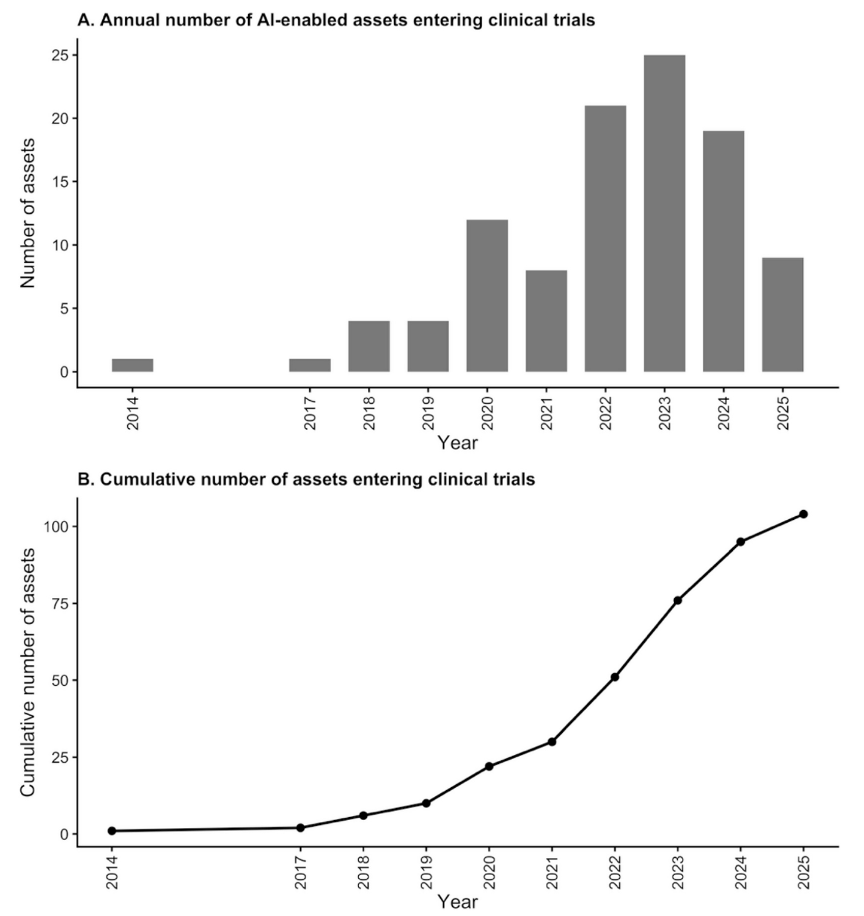
Figure 1. Annual (A) and cumulative (B) AI-enabled assets entering interventional human trials. Source: Haque et al, Cancer Treatment Reviews 2026.
Oncology Dominates
Oncology accounted for 74 of 129 assets (57.3%), far ahead of neurology and psychiatry (21) and autoimmune disease (8). Small molecules made up 103 assets (79.8%), followed by antibodies (15, 11.6%) and vaccines (6, 4.7%).
Only 48 assets (37.2%) went after a novel biological target. Most AI programs are optimizing chemistry against targets we already know, and 16 assets (12.4%) were repurposed drugs. In other words, AI appears to be making drug discovery faster and cheaper on validated biology, but is not yet routinely finding new biology.
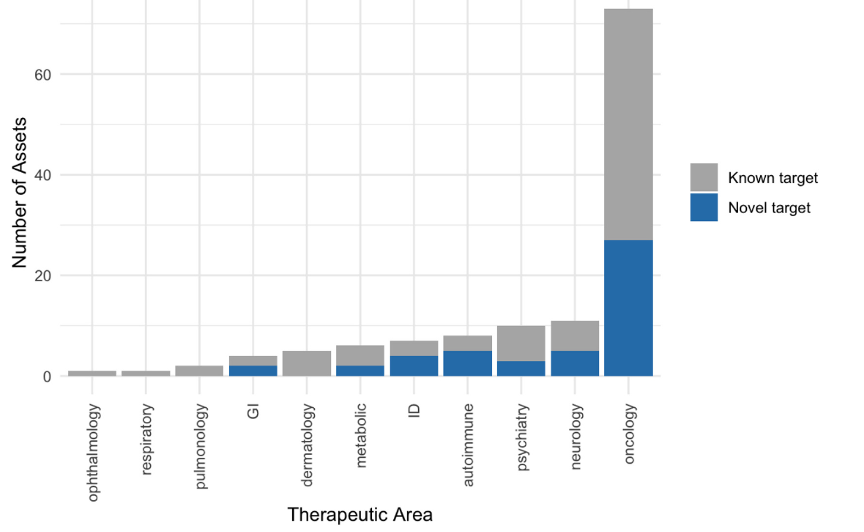
Figure 2. AI-enabled clinical-stage assets by therapeutic area, novel (blue) versus known (grey) target. Source: Haque et al, Cancer Treatment Reviews 2026.
Most Programs Are Still Early-Phase
Of the 129 assets, 72 (55.8%) completed phase 1 and 24 (18.9%) completed phase 2. The path-by-path probability of success was 77.8% for phase 1 (95% CI, 70.2-85.4%) but 19.5% for phase 2 (95% CI, 9.4-29.7%). Median phase 1 enrollment was 56 participants, consistent with small first-in-human studies.
That phase 1 number is encouraging, since AI-designed molecules appear to clear early safety and pharmacokinetic hurdles at high rates. But phase 2 is where efficacy gets tested, and the drop to about one in five looks more similar to conventional drug development. Only five assets have entered or completed phase 3.
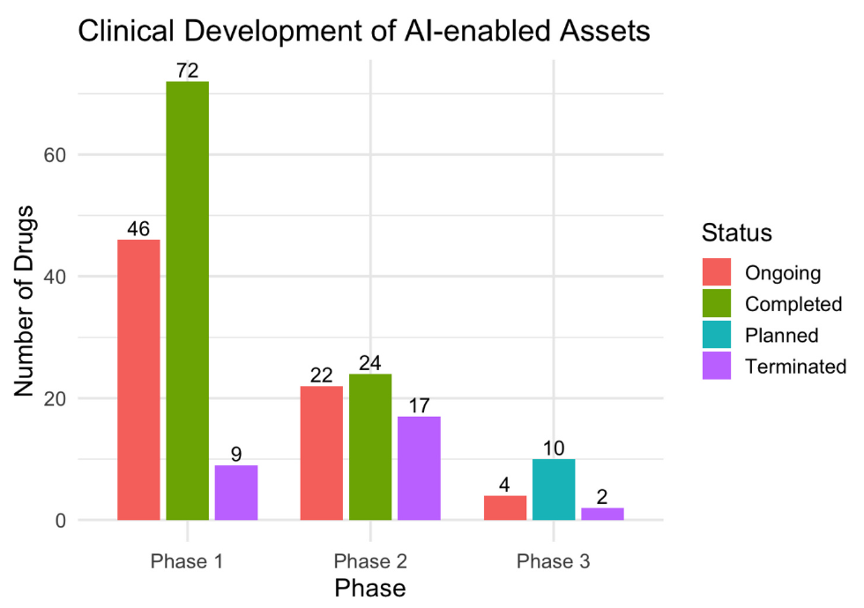
Figure 3. Clinical development of AI-enabled assets by phase and status (ongoing, completed, planned, terminated). Source: Haque et al, Cancer Treatment Reviews 2026.
The Companies Behind the Pipeline
AI-native biotechs reach the clinic quickly, with small teams and a lot of capital per head. The median company entered phase 1 about 6.5 years after founding, with 73 employees and $186.7 million raised.
Table 1. Characteristics of biotechnology companies with AI-enabled assets entering interventional clinical trials through March 1, 2026.
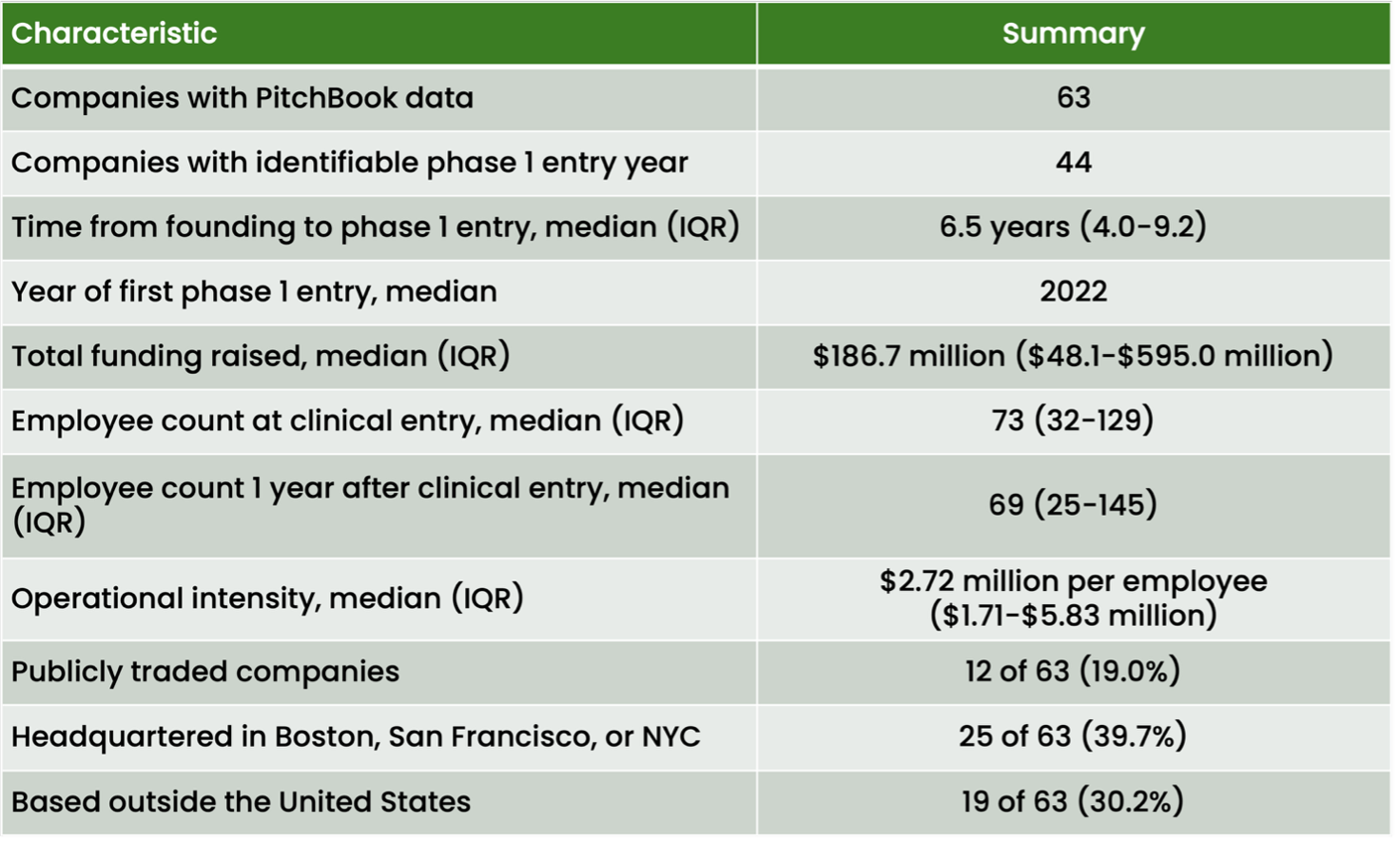
IQR, interquartile range. Operational intensity = total funding raised divided by employee count at Phase 1 entry. Source: Haque et al, Cancer Treatment Reviews 2026.
The "operational intensity" figure of $2.72 million per employee is a proxy but not a productivity score. It fits a model of lean wet-lab teams paired with heavy spending on compute, data, and platform. It may also just reflect how these companies raise money.
The limitation that matters most: a good model does not validate the biology. Even if every AI model behind these 129 assets is technically sound, a well-performing model is not the same thing as a validated biological hypothesis. These models can predict binding affinity, generate drug-like structures, and rank targets from genomic data with impressive accuracy. But they learn from the data we give them, and our understanding of tumor biology, target dependency, the tumor microenvironment, and resistance is still incomplete. A molecule can hit its target exactly as designed and still fail because the target was never truly driving disease in patients.
That is why our phase 2 success rate of 19.5% matters so much: phase 2 is where efficacy, and therefore the biology, gets tested. The 63% of assets aimed at known targets may simply be inheriting validation from decades of conventional research, and the novel-target programs carry the biological risk that no model can yet remove. Until AI-designed drugs clear late-stage trials at higher rates, the burden of proof still rests on experimental and clinical validation, not on model metrics.
Our study has other limitations worth naming. We relied on public disclosures, which will miss unpublished programs and depend on how companies describe their own AI use. Some firms may overstate it for fundraising, while others can use AI without advertising it. We also lacked a matched cohort of conventionally discovered drugs, so we cannot yet say whether AI improves success rates or timelines.
What This Means for Oncology
Oncology is the proving ground for AI drug discovery, so our field will be the first to learn whether it works. Structure-based design and data-rich target selection fit small-molecule cancer drugs well, which helps explain why cancer leads this pipeline.
For clinicians, the practical takeaway is calibrated optimism. An "AI-discovered" label tells you how a molecule was found, not whether it will help your patients. Judge these agents the way we judge any drug: on randomized data, meaningful endpoints, and toxicity.
Our dataset is meant to be a baseline. As these 129 assets move through later-phase trials, we will be able to test the question that matters: does AI-enabled discovery actually lead to more approvals and better outcomes for patients?
Read the Full Article
About Dr. Haque
Waqas Haque, MD, MPH, is a third-year Hematology/Oncology Fellow at the University of Chicago. He recently completed his Internal Medicine Residency at New York University (NYU) in a Clinical Investigator Track. Dr. Haque has balanced his patient care work with a variety of research projects. During his fellowship training at the University of Chicago, he plans to further his work in innovative clinical trial design, value-based care delivery to cancer patients, and clinical investigation.