
Amplifying Nursing Proficiency for the Management of Immune-Related Adverse Events
Expert Perspectives · Lyn Brook · 2025-01-23
i3 Health recently provided an educational activity that challenged nurses’ proficiency for the management of immune-related adverse events (IRAEs), resulting in significant gains in knowledge and confidence in managing these toxicities within their practices.
Immune-Related Adverse Events: Gaps and Challenges
Immune checkpoint inhibitors have dramatically improved survival outcomes in several tumor types, including gastric cancer, head and neck squamous cell carcinoma, Hodgkin lymphoma, Merkel cell carcinoma, metastatic melanoma, non-small cell lung cancer, renal cell carcinoma, and urothelial carcinoma. However, up to 90% of patients receiving these agents may experience delayed-onset autoimmune and systemic inflammatory reactions known as IRAEs, which are different from toxicities associated with chemotherapy and targeted therapies.
IRAEs range in severity and may involve the gastrointestinal system, skin, endocrine glands, liver, and lungs but can potentially affect any tissue. Grade 3/4 IRAEs are of particular concern as they can result in treatment discontinuation and fatalities if not promptly recognized and managed. The rate of severe IRAEs requiring immunosuppression and withdrawal of immunotherapy has been estimated to be as high as 13% for monotherapy and 43% for combination therapy. Therefore, it is imperative that clinicians receive up-to-date educational opportunities for the treatment and management of IRAEs.
Addressing the Gaps
To address the knowledge gaps experienced by nurses regarding the management of IRAEs, i3 Health held a live symposium at the 2023 Greater Los Angeles Oncology Nursing Society (GLAONS) Oncology Care Summit, followed by an online enduring activity which was made available starting October 11, 2023, through October 11, 2024, on i3 Health’s website. The activity was led by an expert in the field, Blanca Ledezma, MSN, NP, AOCNP®, a Nurse Practitioner in Hematology/Oncology at the University of California, Los Angeles (UCLA) Health.
A total of 1,962 learners interacted with the content, and 1,330 participants completed the activity for nursing continuing professional development (NCPD) credit. Most learners were registered nurses, followed by nurse practitioners, advanced practice nurses, physicians, physician assistants, and those who chose “other” as their profession.
The baseline data collected revealed knowledge gaps in the following areas:
- Identifying risk factors predisposing patients to IRAEs
- Distinguishing IRAEs from chemotherapy- and targeted therapy–related adverse events
- Coordination with the interdisciplinary healthcare team to apply evidence-based guidelines
- How mechanisms of action of immunotherapies influence their safety
- Development of patient counseling strategies promoting awareness, self-monitoring, and prompt reporting of IRAEs
Efficacy of the Education
Participants were given a matching pretest and posttest at the beginning and end of the activity, respectively, revealing the following gains in knowledge during the online activity:
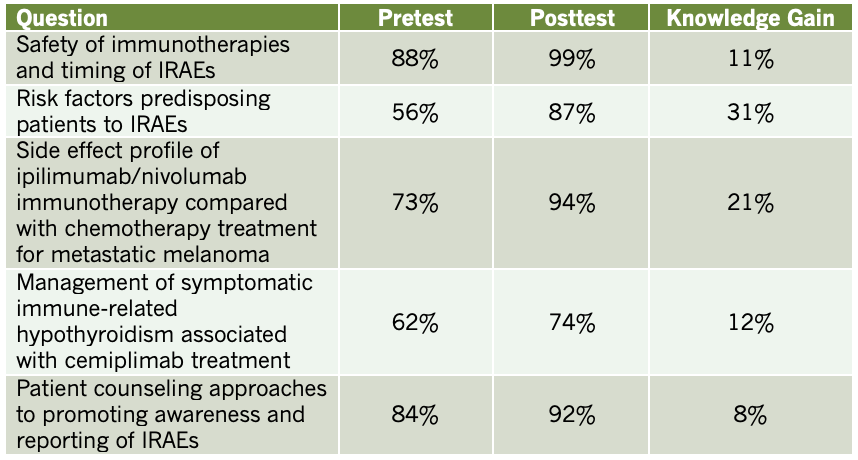
Upon completion of the activity, 96% of learners reported that they felt more confident in treating their patients with IRAEs within their practice, and 95% reported that they felt the material presented would be used to improve the outcomes of their patients.
Future Education
The data revealed by the posttest assessment affirm the effectiveness of online educational content pertaining to the topic of nursing management of IRAEs. Based on these data, i3 Health has determined that the interprofessional team may benefit from NCPD activities that provide education on the nursing management of IRAEs.
Resources
i3 Health (2024). Managing immune-related adverse events to ensure optimal cancer immunotherapy outcomes: the nurse’s view: activity outcomes report. Data on file.