
Reviews
PD-1/PD-L1 Inhibitors Plus Chemotherapy in Advanced Squamous NSCLC: Phase 3 Meta-Analysis
Pan et alTranslational Cancer Research
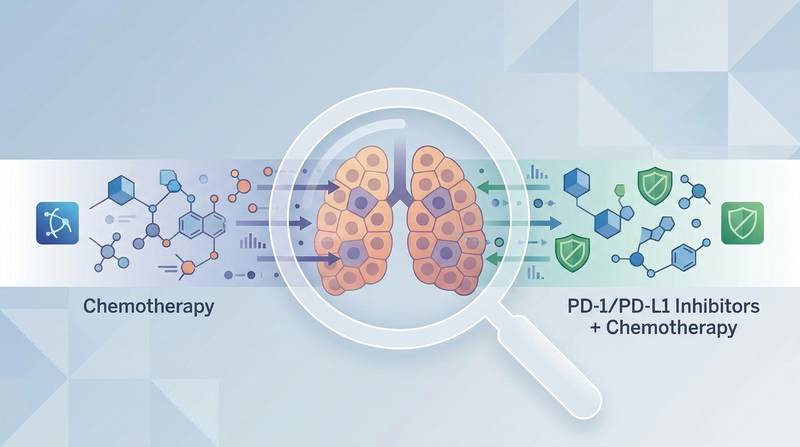
A systematic review and meta-analysis of 14 phase 3 randomized controlled trials evaluated the efficacy and safety of programmed death-1 (PD-1) or programmed death-ligand 1 (PD-L1) inhibitors combined with chemotherapy versus chemotherapy alone in 4,481 patients with stage IIIB–IV squamous non-small cell lung cancer (NSCLC), comprising 2,466 patients in the chemoimmunotherapy arm and 2,015 patients in the chemotherapy arm. The certainty of evidence was evaluated using the GRADE approach and ranged from moderate to high.
Patients receiving PD-1/PD-L1 inhibitors plus chemotherapy demonstrated statistically significant improvements in survival endpoints compared to chemotherapy alone. Chemoimmunotherapy significantly reduced the risk of death (HR: 0.73; 95% CI: 0.67–0.79; P < 0.001), with overall survival benefits maintained over follow-up periods extending from 6 to 60 months. Progression-free survival was also markedly superior (HR: 0.54; 95% CI: 0.48–0.60; P < 0.001), with improvements evident across 6 to 24 months of follow-up. Subgroup analyses demonstrated that patients with PD-L1 expression of 50% or higher achieved superior survival outcomes with the combination regimen.
Tumor response metrics favored the chemoimmunotherapy arm, which yielded a significantly higher objective response rate (RR: 1.50; 95% CI: 1.40–1.61; P < 0.001) and a longer duration of response (HR: 0.48; 95% CI: 0.41–0.55; P < 0.001). However, the addition of checkpoint inhibitors was associated with an increased incidence of total and grade 3–5 immune-related adverse events. Furthermore, rates of treatment-emergent and treatment-related adverse events leading to treatment discontinuation, as well as treatment-emergent adverse events leading to death, were higher in the combination group, underscoring the necessity of close toxicity surveillance and individualized risk-benefit assessment in clinical practice.
Key Takeaways
- In advanced stage IIIB–IV squamous NSCLC, adding PD-1/PD-L1 inhibitors to chemotherapy significantly reduced the risk of death (HR: 0.73, 95% CI: 0.67–0.79, P < 0.001) and disease progression (HR: 0.54, 95% CI: 0.48–0.60, P < 0.001), with the greatest survival benefits observed in patients with PD-L1 expression ≥50%.
- The chemoimmunotherapy combination produced a significantly higher objective response rate (RR: 1.50, 95% CI: 1.40–1.61, P < 0.001) and prolonged the duration of response (HR: 0.48, 95% CI: 0.41–0.55, P < 0.001) relative to chemotherapy alone.
- Safety analysis revealed an increased risk of total and grade 3–5 immune-related adverse events, as well as higher rates of treatment-emergent adverse events leading to treatment discontinuation and death.
Read the original sourceTranslational Cancer Research