
Clinical Trials
Talazoparib inhibits BRCA-mutant and wild-type breast cancer cell lines
Lee et alJournal of Breast Cancer
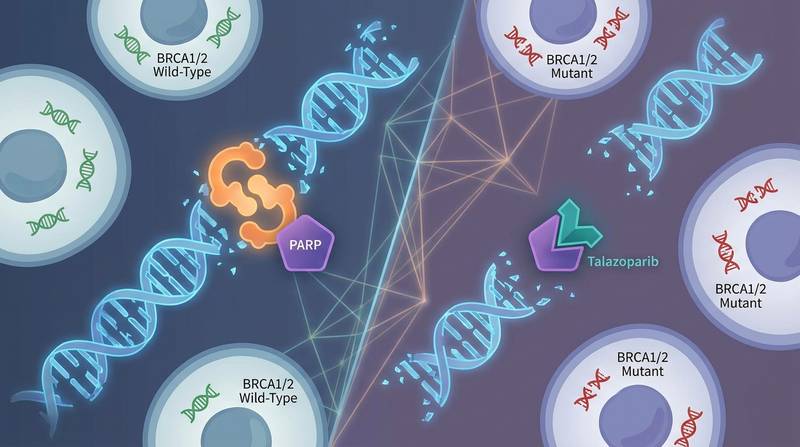
Although the potent poly(ADP-ribose) polymerase (PARP) inhibitor talazoparib is currently approved for patients with germline BRCA1/2-mutated, HER2-negative locally advanced or metastatic breast cancer, preclinical evidence suggests anti-tumor activity may extend beyond homologous recombination-deficient tumors. In an in vitro study evaluating 21 breast cancer cell lines comprising both BRCA1/2-mutated and wild-type phenotypes, investigators examined cell proliferation, cell cycle dynamics, DNA damage accrual, and apoptosis following talazoparib exposure.
Talazoparib displayed antiproliferative activity in both BRCA1/2-mutant and wild-type cell lines within long-term colony formation assays. In talazoparib-sensitive lines, cytotoxicity was driven by potent and sustained chromatin trapping of PARP1, which led to marked accumulation of single-stranded (phosphorylated RPA) and double-stranded (γ-H2AX) DNA damage. This genomic insult induced abnormal mitotic nuclei formation, triggered G2/M phase cell cycle arrest, and culminated in apoptosis, as confirmed by cleaved caspase-3 expression and Annexin V positivity. These preclinical mechanisms suggest that talazoparib sensitivity is not strictly confined to BRCA-deficient states, supporting further investigation of its clinical efficacy in broader breast cancer populations.
Key Takeaways
- Talazoparib demonstrated antiproliferative efficacy across both BRCA1/2-mutant and BRCA1/2 wild-type breast cancer cell lines in long-term colony formation assays.
- Sensitive breast cancer cell lines exhibited potent and sustained PARP1 trapping on chromatin, single- and double-stranded DNA damage accumulation marked by phosphorylated RPA and γ-H2AX, abnormal mitotic nuclei formation, G2/M arrest, and apoptotic cell death.
- These mechanistic findings support the potential therapeutic utility of talazoparib beyond its current regulatory indication restricted to germline BRCA1/2-mutated tumors.
Read the original sourceJournal of Breast Cancer