
Clinical Trials
Phase 1 Trial of SL-172154 Plus Azacitidine in Higher-Risk MDS and TP53-Mutated AML
Daver et alWiley: Cancer
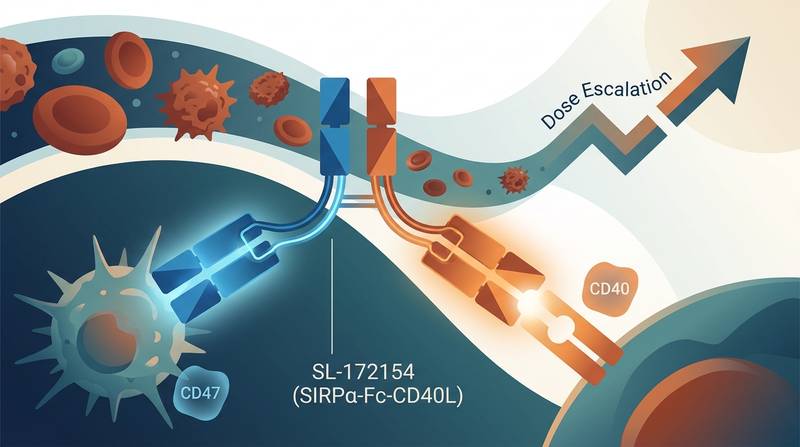
In a phase 1 dose-escalation and expansion study, investigators evaluated the bispecific CD47 inhibitor and CD40 agonist Fc-fusion protein SL-172154 (SIRPα-Fc-CD40L) alone and in combination with azacitidine (AZA) in 81 patients with higher-risk myelodysplastic syndrome (HR-MDS, n = 33) or acute myeloid leukemia (AML, n = 48).
Dose escalation tested 1, 3, and 6 mg/kg of SL-172154 as monotherapy or with AZA in 37 patients with relapsed or refractory HR-MDS or AML. Infusion-related reactions emerged as the most common treatment-related toxicity and led to a dose-limiting toxicity at the 6 mg/kg level. Pharmacodynamic assessments confirmed target engagement of both CD47 and CD40 on leukemic blasts, myeloid cells, and lymphoid cells.
Based on safety and tolerability findings, a dose of 3 mg/kg SL-172154 in combination with AZA was advanced into dose expansion (n = 44). This cohort enrolled previously untreated patients with HR-MDS (n = 21 with TP53 mutations, n = 3 with TP53 wild-type) and AML (n = 21 with TP53 mutations). Complete remission (CR) was achieved in 43% (10 of 24) of patients with HR-MDS and 29% (6 of 21) of patients with TP53-mutant AML. Median overall survival was 11.0 months (95% CI, 5.0–15.6) in the HR-MDS group and 11.7 months (95% CI, 1.97–NE) in the TP53-mutant AML group. Furthermore, cytogenetic evaluation showed complete cytogenetic CR in 6 of the 10 HR-MDS responders and 3 of the 6 TP53-mutant AML responders.
Although SL-172154 combined with azacitidine demonstrated an acceptable safety profile and induced favorable CR and cytogenetic response rates in difficult-to-treat TP53-mutated disease, overall survival times did not show substantial improvement over historical benchmarks established by azacitidine alone or azacitidine with venetoclax.
Key Takeaways
- In previously untreated patients receiving 3 mg/kg SL-172154 plus azacitidine, complete remission occurred in 43% (10/24) of higher-risk MDS patients (median OS 11.0 months; 95% CI, 5.0–15.6) and 29% (6/21) of TP53-mutated AML patients (median OS 11.7 months; 95% CI, 1.97–NE).
- Among responders, complete cytogenetic remission was documented in 6 of 10 higher-risk MDS patients and 3 of 6 TP53-mutated AML patients, though median overall survival did not substantially improve over historical benchmarks for azacitidine or azacitidine plus venetoclax.
- Infusion-related reactions represented the most frequent SL-172154-related adverse event, resulting in a dose-limiting toxicity at 6 mg/kg and establishing 3 mg/kg as the selected dose for combination therapy.
Read the original sourceWiley: Cancer