
Cultivating Proficiency in MRD Testing for the Management of Hematologic Malignancies
Expert Perspectives · Lyn Brook · 2025-03-21
i3 Health recently provided an educational activity that challenged clinicians’ proficiency in enhancing measurable residual disease (MRD) testing in hematologic malignancies. The results of this activity showed a positive trend in increased knowledge in the utility of MRD status and indications for novel MRD testing methods for the management of hematologic malignancies.
Gaps and Challenges in MRD Testing
Measurable residual disease is defined as the presence of residual cancer cells that remain in the body during or after treatment, do not cause any physical signs or symptoms, and are not detected by traditional morphological methods. Instead of waiting for disease relapse before initiating subsequent therapy, MRD could be tested for therapeutic susceptibility and treated to increase the chance of eradication of all tumor cells and prevent the likelihood of cancer-promoting factors.
New assays developed to more precisely monitor MRD include multiparametric flow cytometry, allele-specific oligonucleotide quantitative polymerase chain reaction (ASO-PCR), digital PCR, and next-generation sequencing (NGS), which offer greater sensitivity than conventionally employed tests. Despite these developments, discrepancies in MRD monitoring, availability, accessibility, and affordability exist between different institutions and countries. Several technologies are available for MRD quantification, but the assays and reporting methods lack standardization and comparability.
Addressing the Gaps
To address the knowledge gaps experienced by clinicians regarding the management of hematologic malignancies through MRD testing, i3 Health curated the online CME-approved activity titled Enhancing MRD Testing in Hematologic Malignancies: When Negativity is a Positive Thing. The online enduring activity was made available on February 20, 2024, through February 19, 2025, on i3 Health’s website. An expert in the field, Noopur Raje, MD, Professor of Medicine at Harvard Medical School and Director of the Center for Multiple Myeloma at Massachusetts General Cancer Center, chaired the activity.
The baseline data collected revealed knowledge gaps in the following areas:
- Distinguishing the advantages and limitations of current MRD detection methods
- Evaluating consensus recommendations on indications for MRD testing in hematologic malignancies
- Explaining the current and potential roles of MRD status and depth of response as a biomarker in clinical trials
- Assessing the clinical utility of MRD in prognosis and treatment of selected hematologic malignancies, including acute lymphoblastic leukemia, chronic lymphocytic leukemia, and multiple myeloma
Efficacy of the Education
Participants were given a matching pretest and posttest at the beginning and end of the activity, respectively, revealing the following results:
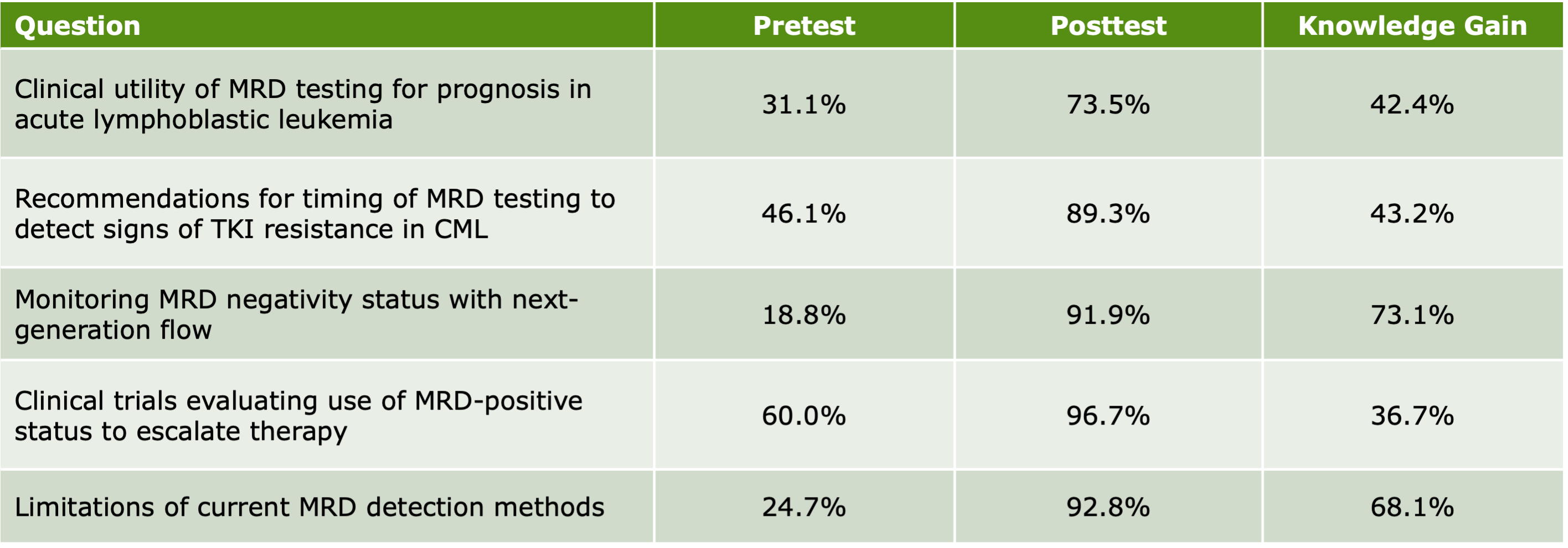 TKI = tyrosine kinase inhibitor; CML = chronic myeloid leukemia.
Upon completion of the activity, 84% of learners reported that they felt more confident in using MRD testing, and 83% reported that they felt the material presented would be used to improve the outcomes of their patients.
Future Education
The data revealed by the posttest assessment affirm the effectiveness of online educational content pertaining to the topic of MRD testing. Based on these data, i3 Health has determined that the multidisciplinary team may benefit from CME activities that provide education on the following:
- Advantages and limitations of current MRD detection methods
- Consensus recommendations on indications for MRD testing in hematologic malignancies
- Current and potential roles of MRD status and depth of response as a biomarker in clinical trials
- Clinical utility of MRD in prognosis and treatment of hematologic malignancies
Resources
i3 Health (2025). Enhancing MRD testing in hematologic malignancies: When negativity is a positive thing: activity outcomes report. Data on file.