
Elevating Clinician Competence in the Management of Early-Stage Non–Small Cell Lung Cancer
Expert Perspectives · Lyn Brook · 2024-11-08
i3 Health recently provided an educational activity that challenged clinicians’ knowledge proficiency regarding early-stage non–small cell lung cancer (NSCLC).
NSCLC: Gaps and Challenges
An estimated 234,580 new cases of lung cancer are reported in the United States annually, and 125,070 people die of the disease. Of the 81% of cases classified as non–small cell, roughly 25% are diagnosed at an early stage when the disease is still resectable. Surgery remains the primary treatment option for medically fit patients and is associated with a 5-year overall survival rate ranging from 50% to 70% for stage I disease and 10% to 30% for stage IIIA. Stereotactic ablative radiation is the recommended initial therapy for patients with early-stage NSCLC who are unfit for or unwilling to undergo surgery. However, most patients are diagnosed at a locally advanced or metastatic stage, making systemic therapy the cornerstone of management. Although 70% of patients receiving first-line classical doublet chemotherapy demonstrate clinical benefit, most develop progressive disease within 5 months of their final cycle. Recently, the use of tumor histology in determining optimal treatment strategies and relevant molecular biomarkers to further refine selection of novel therapies has improved outcomes for some patients. Unfortunately, the 5-year survival rate plummets from 61% when diagnosed at a localized stage to 7% when cancer has metastasized, indicating a need for continued research on more effective approaches to tumor control.
Addressing the Gaps
To address the knowledge gaps experienced by clinicians regarding NSCLC, i3 Health curated a continuing medical education (CME)/nursing continuing professional development (NCPD)–accredited live meeting series and online video viewpoint strategy session. A total of six live visiting faculty meetings were held between October 2023 and May 2024, with an accompanying online video viewpoint strategy session made available on i3 Health’s website from August 2023 until July 2024. Leading this activity were two experts in the field of NSCLC: Helena A. Yu, MD, an Associate Attending Physician at Memorial Sloan Kettering Cancer Center, and Jamie E. Chaft, MD, an Associate Attending Physician at Memorial Sloan Kettering Cancer Center.
Between the live meetings and the online activity, a total of 987 learners engaged with the content, and 574 completed the activity for credit. Most participants were physicians and registered nurses, followed by nurse practitioners, physician assistants, pharmacists, advanced practice nurses, and those who chose “other” as their profession.
The baseline data collected revealed knowledge gaps in the following areas:
- Identifying the correct tumor stage and appropriate management approach for NSCLC based on the latest evidence
- Distinguishing biomarkers for early-stage NSCLC that can inform individualized treatment strategies
- Appraising efficacy and safety data of novel adjuvant therapies for patients with NSCLC as elucidated by recent clinical trials
- Applying strategies to prevent and mitigate adverse events associated with novel adjuvant therapies for early-stage NSCLC
Efficacy of the Education
Participants were given a matching pretest and posttest at the beginning and end of the activity, respectively:
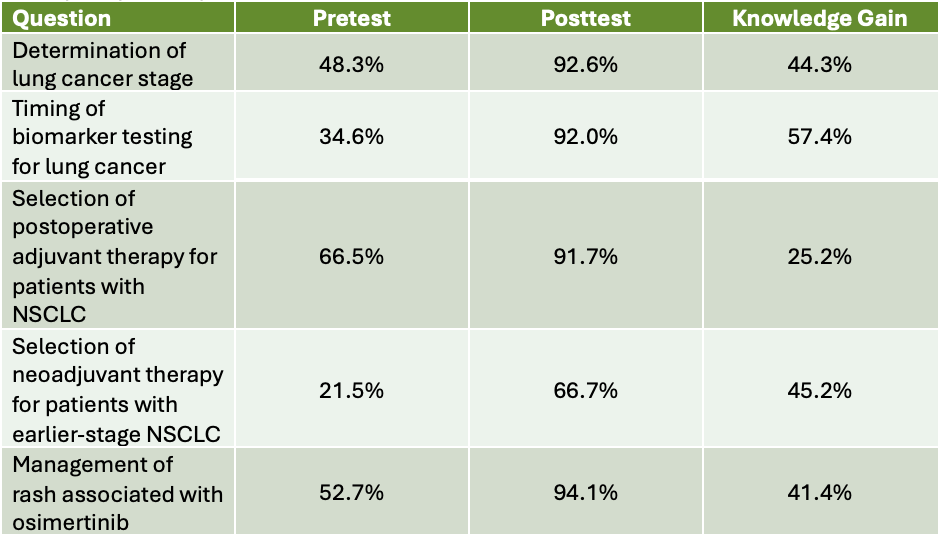
Upon completion of the activity, 93% of learners reported that they felt more confident in treating their patients with NSCLC, and 93% reported that they felt the material presented would be used to improve the outcomes of their patients.
Future Education
The data revealed by the posttest assessment affirm the effectiveness of online educational content pertaining to the topic of early-stage NSCLC. Based on these data, i3 Health has determined that the interprofessional team may benefit from CME/NCPD activities that provide NSCLC education on:
- Implications of staging and biomarker status for prognostication and treatment selection in NSCLC
- Recent clinical trial findings on efficacy and safety of novel therapies in the treatment of NSCLC
- Strategies to optimizing the safety and tolerability of novel therapies for NSCLC
Resources
i3 Health (2024). Leveraging the growing arsenal of adjuvant therapies for early-stage non–small cell lung cancer: activity outcomes report. Data on file.