
Enhancing Knowledge of Emerging Treatment Strategies and Latest Advances in Follicular Lymphoma Therapy
Expert Perspectives · Lyn Brook · 2024-09-11
i3 Health recently provided an educational activity that has challenged knowledge gaps experienced by clinicians regarding the latest evidence for follicular lymphoma therapy.
Of the estimated 80,620 new cases of non-Hodgkin lymphoma diagnosed each year in the United States, approximately 22% are follicular lymphoma, an indolent, difficult-to-treat B-cell malignancy. Despite the introduction of novel therapies during the past decade, complications such as delayed presentation and treatment, evolving disease subtypes, and unclear timing and duration of therapy continue to hamper patient outcomes, and multiple recurrences with available therapies are common. Additional challenges in management include a lack of consensus surrounding the optimal timing of therapy, the role of transplant, and the use of novel therapies to keep the rate of durable remissions high among patients with follicular lymphoma. Due to this, it is imperative that clinicians receive up-to-date educational opportunities for the latest advances in follicular lymphoma treatment and therapy.
To address the knowledge gaps experienced by clinicians regarding the latest evidence for follicular lymphoma therapy, i3 Health curated a live meeting series held between June 10, 2022, and June 12, 2024. A total of 12 live meetings were held with a sum of 154 participants, most of whom were physicians, followed by nurse practitioners, pharmacists, physician assistants, nurses, and those who chose “other” as their profession. Leading the live meeting activities were two key experts in the field: Christopher R. Flowers, MD, MS, Division Head ad interim in the Division of Cancer Medicine at The University of Texas, MD Anderson Cancer Center, and Sarah Rutherford, MD, an Assistant Professor in the Division of Hematology/Oncology at Weill Cornell Medicine.
The baseline data collected revealed knowledge gaps in the following areas:
- Evaluating molecular profiling recommendations that can inform personalized care plans for patients with follicular lymphoma
- Differentiating the mechanisms of action, efficacy, and safety of emerging agents for follicular lymphoma
- Assessing the clinical application of novel therapeutic strategies for patients with newly diagnosed and relapsed/refractory follicular lymphoma
Participants were given a matching pretest and posttest at the beginning and end of the activity, respectively:
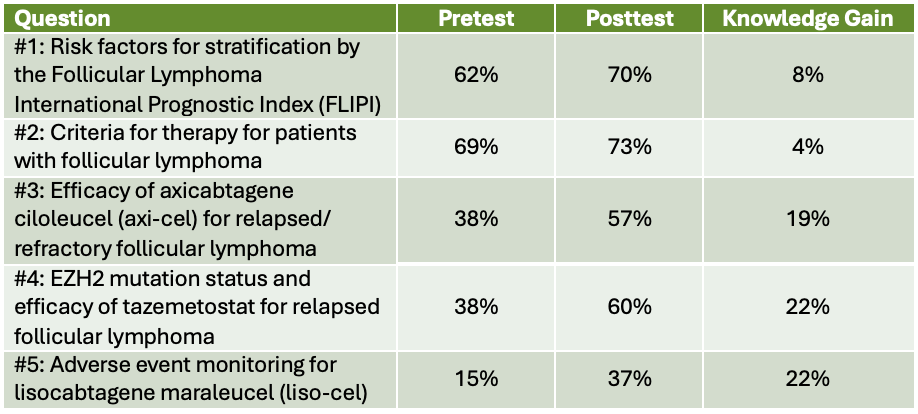
Upon completion of the activity, 83% of learners who completed the evaluation reported that they felt more confident in treating their patients with follicular lymphoma, and 87% felt the material presented would be used to improve the outcomes of their patients.
The data revealed by the posttest assessment affirm the effectiveness of live meeting series educational content pertaining to the topic of follicular lymphoma. Based on these data, i3 Health has determined that the multidisciplinary team may benefit from CME activities that provide up-to-date follicular lymphoma education.
Resources
i3 Health (2024). Tailoring therapy for follicular lymphoma based on the latest evidence: activity outcomes report. Data on file.