
From Knowledge to Practice: AI's Growing Role in Oncology
Expert Perspectives · Waqas Haque, MD, MPH · 2025-09-09
From summarizing the latest research to personalizing patient care, the role of artificial intelligence (AI) in oncology is continually expanding. In this month’s edition of The Way Ahead: The Convergence of Technology and Cancer Care, Waqas Haque, MD, MPH, second-year Hematology/Oncology Fellow at the University of Chicago, explores an innovative abstract summarization tool, new recommendations for AI-powered clinical trial matching, and a prognostic test paving the way for personalized medicine in prostate cancer.
ASCOmind: Taming the Information Overload
The one word I often use here to describe the American Society of Clinical Oncology (ASCO) Annual Meeting is “overwhelming.” Keeping up with the thousands of abstracts presented at major oncology conferences and sifting through the most practice-changing ones poses a monumental task.
To address this challenge, researchers have developed ASCOmind, a powerful AI agent designed to streamline the process of evidence synthesis. As discussed in our recent podcast episode with Dr. Xiaoyan Wang and Dr. William Oh, ASCOmind utilizes a framework of six collaborative AI agents to automate the analysis of ASCO abstracts with remarkable speed and accuracy.
A study presented at the last ASCO Annual Meeting demonstrated ASCOmind’s capabilities by applying it to multiple myeloma abstracts. The system was able to process and categorize abstracts, extract 51 predefined data elements, and generate visual summaries in under 10 minutes per abstract—a task that would take a human reviewer over an hour. The preliminary analysis showed high accuracy, with only one minor misclassification that was easily corrected.
The success of ASCOmind in a single hematologic malignancy is just the beginning. The potential to validate this technology in other fields is vast, and the use cases are endless. Imagine a “mobile oncologist app” that not only keeps oncologists up to date with the latest research but also provides instant charts and graphs for papers and facilitates networking at conferences.
The Future of Clinical Trial Matching is a Human-AI Partnership
Finding the right clinical trial for a patient can be a time-consuming and often inefficient process. A recent article in the ASCO Daily News highlights the move towards joint human and AI teams to bring real-time trial matching to the point of care. The article outlines four practical imperatives for the successful implementation of human-centered AI in trial matching:
- External generalizability: Ensuring AI models are effective in diverse clinical settings
- Drift and bias audits: Continuously monitoring and retraining models to maintain accuracy
- Explainability: Building trust by providing clear reasons for AI-generated matches
- Embedded workflows: Seamlessly integrating AI tools into existing electronic health records
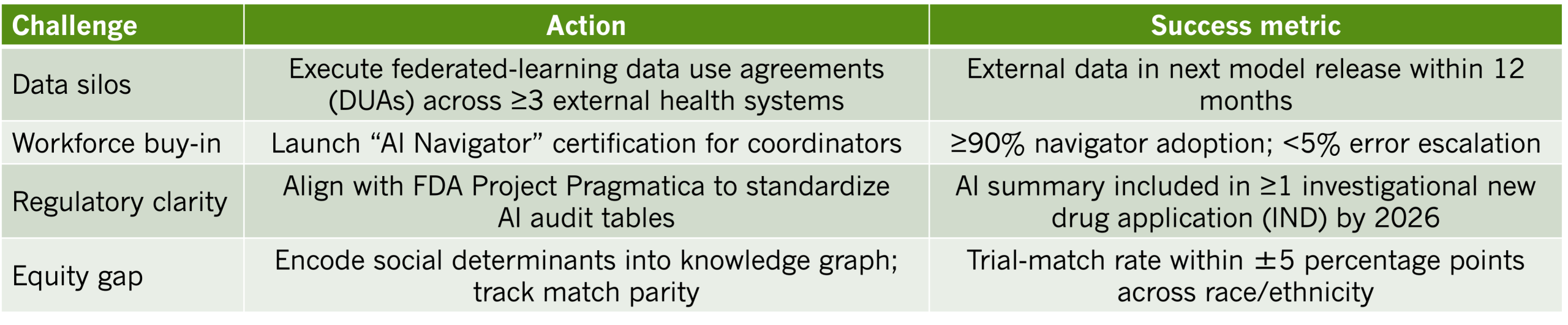
Looking ahead, a “Human Plus AI Trial Matching Playbook for 2025–2027” provides a roadmap for the future. The playbook addresses current challenges such as fragmented data and manual chart review, and it outlines next steps for developing secure data pipelines, validating AI models, and creating user-friendly interfaces. By 2027, the goal is to see a significant reduction in the time it takes to enroll patients in trials, an increase in the diversity of trial participants, and a clear return on investment for healthcare systems.
Human Plus AI Trial Matching Playbook for 2025–2027
ArteraAI: a New Frontier in Prognostic Testing
In a landmark achievement, ArteraAI has received US FDA De Novo marketing authorization for its AI-powered digital pathology software, ArteraAI Prostate. This is the first prognostic digital pathology test for prostate cancer to receive FDA clearance, marking a significant step forward in personalized medicine. We also previously featured their solutions on our podcast, which you can listen to here.
The ArteraAI Prostate test is a category-defining tool that has been trained on data from thousands of patients. It is also the first prostate cancer risk stratification test to have its calibrated outputs validated, a crucial factor for its clinical utility. This groundbreaking technology provides personalized prognostic information at the point of care, empowering clinicians and patients to make more informed treatment decisions.
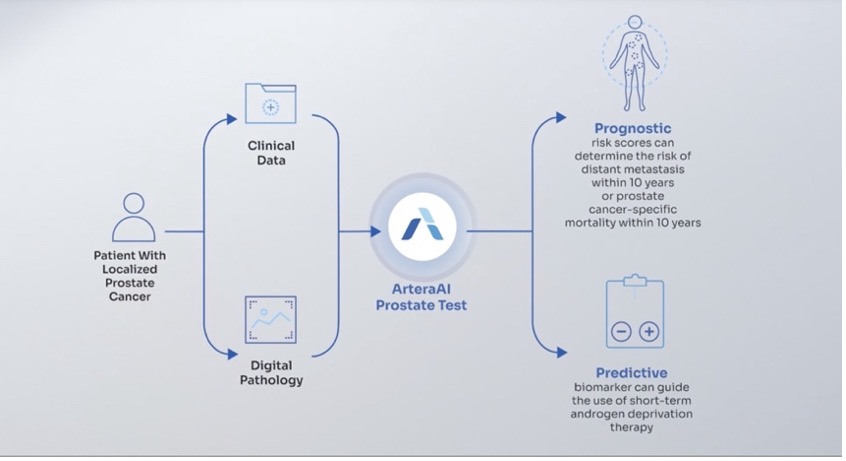
The FDA’s De Novo authorization for ArteraAI Prostate not only establishes a new product category for AI-powered risk stratification tools but also includes a Predetermined Change Control Plan. This will allow ArteraAI to expand the platform’s capabilities to include additional digital pathology scanners without the need for further 510(k) submissions. This accomplishment is a major milestone in ArteraAI’s mission to personalize medical treatments for cancer patients and oncologists globally and will unlock the potential to help patients with other cancer types.
About Dr. Haque
Waqas Haque, MD, MPH, is a Hematology/Oncology Fellow at the University of Chicago. He recently completed his Internal Medicine Residency at New York University (NYU) in a Clinical Investigator Track. Dr. Haque has balanced his patient care work with a variety of research projects. During his fellowship training at the University of Chicago, he plans to further his work in innovative clinical trial design, value-based care delivery to cancer patients, and clinical investigation.