
Advancing Immunotherapy Proficiency in Recurrent/Metastatic HNSCC
Expert Perspectives · Keira Smith · 2025-07-24
i3 Health recently provided an educational symposium and enduring activity that challenged clinicians’ proficiency in the use of immunotherapy for recurrent/metastatic head and neck squamous cell carcinoma (HNSCC), resulting in increased knowledge of biomarkers, immune checkpoint inhibitors, immune-mediated adverse event management, and multidisciplinary team approaches to surveillance and survivorship care.
HNSCC: Gaps and Challenges
Head and neck squamous cell carcinoma represents a heterogeneous group of tumors originating in the mucosal epithelium of the oral cavity, pharynx, and larynx. With an aggressive disease course, recurrence rates for HNSCC are high, and prognosis remains poor for advanced-stage tumors despite advances in multimodal therapies. Immunotherapies, including immune checkpoint inhibitors, costimulatory agents, antigenic vaccines, adoptive T-cell transfer, oncolytic virus therapy, and epidermal growth factor receptor (EGFR)–targeted therapies have demonstrated significant efficacy for the treatment of HNSCC. However, a broadened understanding of disease pathogenesis, molecular and clinical biomarkers, emerging efficacy and safety data, strategies to prevent and mitigate immune-mediated adverse events, and implementation of a multidisciplinary approach for surveillance and survivorship are necessary in order to optimize use of immunotherapies.
Addressing the Gaps
To address the knowledge gaps experienced by the oncology care team, i3 Health held an ancillary educational event at the 2024 Multidisciplinary Head and Neck Cancers Symposium in Phoenix, Arizona, on February 29, 2024. The live event was followed by an online enduring activity which was made available on i3 Health’s website from April 3, 2024, through April 2, 2025. The activity was led by two experts in the field: Glenn J. Hanna, MD, Director of the Center for Cancer Therapeutic Innovation and Medical Oncologist in the Center for Head & Neck Oncology at Dana-Farber Cancer Institute; and Deborah Wong, MD, PhD , Associate Clinical Professor of Medicine in the Division of Hematology-Oncology at UCLA Medical Center
Between the live and enduring components, a total of 1,739 learners interacted with the content, and 835 participants completed the activity for CME or NCPD credit. Most learners were registered nurses, followed by specialty physicians, primary care physicians, nurse practitioners, physician assistants, residents or fellows, and those who chose “other” as their profession.
The baseline data collected revealed knowledge gaps in the following areas:
- Distinguishing histopathological, molecular, and clinical biomarkers that can inform prognosis and management of HNSCC
- Assessing emerging efficacy and safety data on novel immune checkpoint inhibitors for recurrent/metastatic HNSCC
- Applying strategies to prevent and mitigate immune-mediated adverse events
- Applying a multidisciplinary team approach to the implementation of surveillance and survivorship care plans for patients with recurrent/metastatic HNSCC
Efficacy of the Education
Participants were given a matching pretest and posttest at the beginning and end of the activity, respectively, revealing the following gains in knowledge during the online activity:
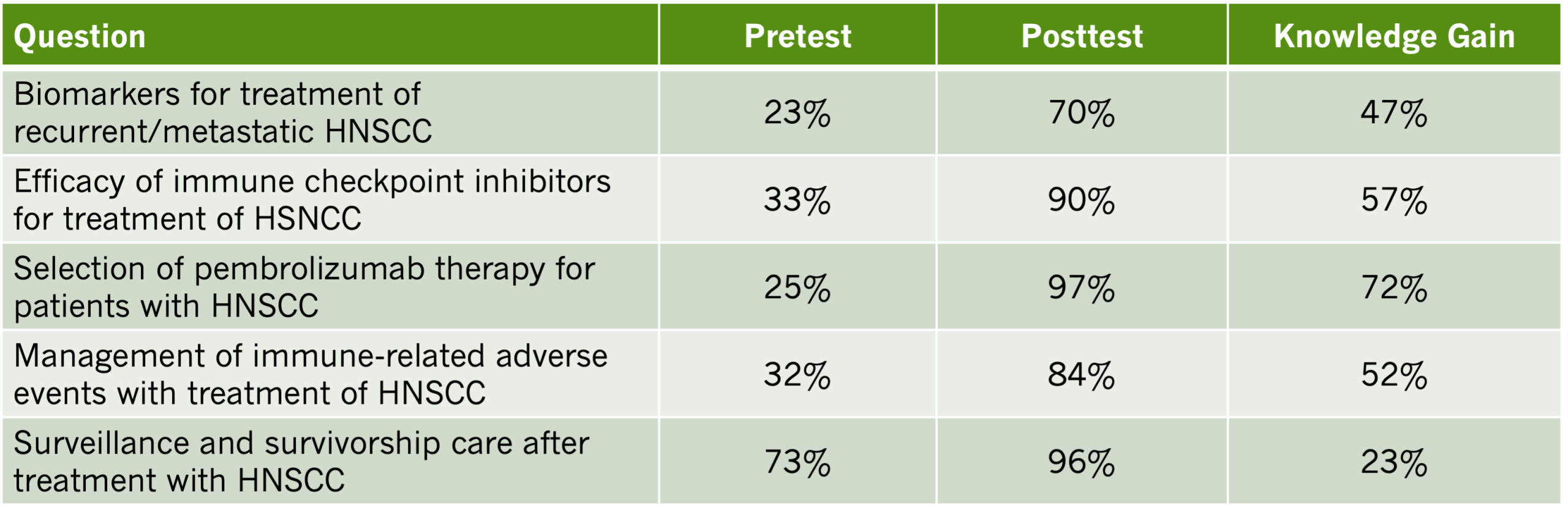
Upon completion of the activity, 92% of learners reported that they felt more confident in treating their patients with HNSCC, and 92% reported that they felt the material presented would be used to improve the outcomes of their patients.
Future Education
The data revealed by the posttest assessment affirm the effectiveness of online educational content pertaining to the topic of immunotherapy for HNSCC. Based on these data, i3 Health has determined that the interprofessional team may benefit from NCPD activities that provide education on HNSCC and immunotherapy.
Resources
i3 Health (2025). Recurrent/metastatic HNSCC: harnessing immunotherapy in comprehensive care. Data on file.