
How a Multi-LLM Ensemble Accelerates Drug Repurposing
Expert Perspectives · Keira Smith · 2026-07-06
Finding a new use for existing drugs has the potential to transform outcomes for refractory non–small cell lung cancer (NSCLC), yet the evidence needed to spark a clinical trial is often hidden in plain sight. While thousands of case reports detailing successful off-label drug uses are published, the manual labor required to find, verify, and summarize them creates a massive bottleneck in the drug repurposing pipeline. A recent study in npj Precision Oncology introduces TheraMind, an innovative artificial intelligence (AI) framework that leverages a multi-LLM ensemble to automate this search and identify clinically relevant case reports with remarkable precision. In this edition of The Way Ahead, Waqas Haque, MD, MPH, Hematology/Oncology Fellow at the University of Chicago, explores how this technology is transforming years of unstructured medical narratives into actionable insights that could significantly accelerate the delivery of new treatments to the bedside.
The Case for Drug Repurposing
Refractory NSCLC has led to more than double the number of deaths than second-ranking colorectal cancer and third-ranking pancreatic cancer combined. For patients facing this disease, the search for new options is urgent. Drug repurposing offers an appealing shortcut: existing agents that have already undergone rigorous regulatory approval come with years of established safety profiles, allowing oncologists to bypass preclinical work and phase 1 trials. The catch is evidence. Oncologists tend to trust a repurposing candidate only when they can see real patients who benefited, and finding those published case reports buried across thousands of citations on PubMed has long been a manual, labor-intensive bottleneck.
Overcoming the Bottleneck
A new study in npj Precision Oncology introduces TheraMind, an explainable AI system designed to break that bottleneck. Developed by a team at Binghamton University and Sostos Inc., TheraMind uses large language models (LLMs) to automatically retrieve and evaluate case reports supporting drug repurposing in NSCLC.
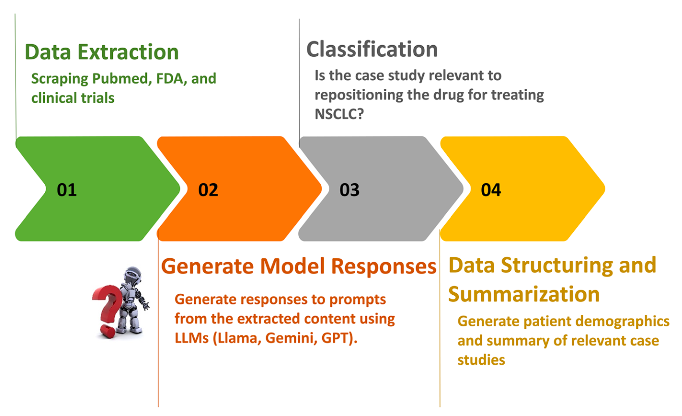
Figure from TheraMind study: Overview of the data extraction and decision module (the four-stage pipeline: scraping → model responses → classification → structured output).
The pipeline screened 10,023 PubMed-indexed case reports across 18 candidate drugs previously flagged by the group's multi-omics AI screening work. Each report was interrogated with four standardized yes/no prompts:
1) Was the patient diagnosed with NSCLC?
2) Was the study drug used to treat it?
3) Was therapy prematurely discontinued?
4) Was the outcome favorable?
Reports passing all four criteria were flagged as relevant. What sets TheraMind apart is its multi-LLM ensemble architecture. Rather than relying on a single model, which is an approach prone to hallucinations and error propagation, the system runs GPT-4o-mini, Gemini-2.0-Flash, and Llama-3-8B in parallel, then uses majority voting to reach consensus. A case is retained only when at least two of the three models agree.
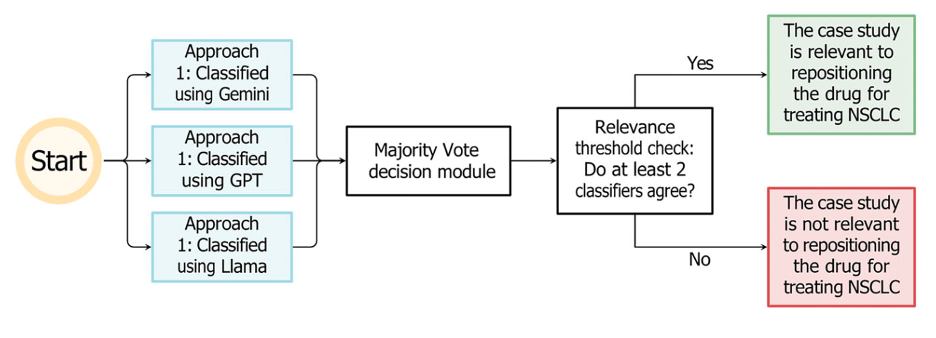
Figure from TheraMind study: Majority vote ensemble classification workflow.
TheraMind’s Efficacy
The majority-vote ensemble achieved 92% recall and 99.7% specificity in detecting clinically relevant reports, outperforming both a rule-based decision tree and individual-model classifiers. From the full corpus, the system surfaced 26 case reports relevant to NSCLC repurposing. For each of the case reports, TheraMind also extracted structured patient demographics and generated concise study summaries. This allows unstructured narratives to become machine-readable packages that can be used for further analyses.
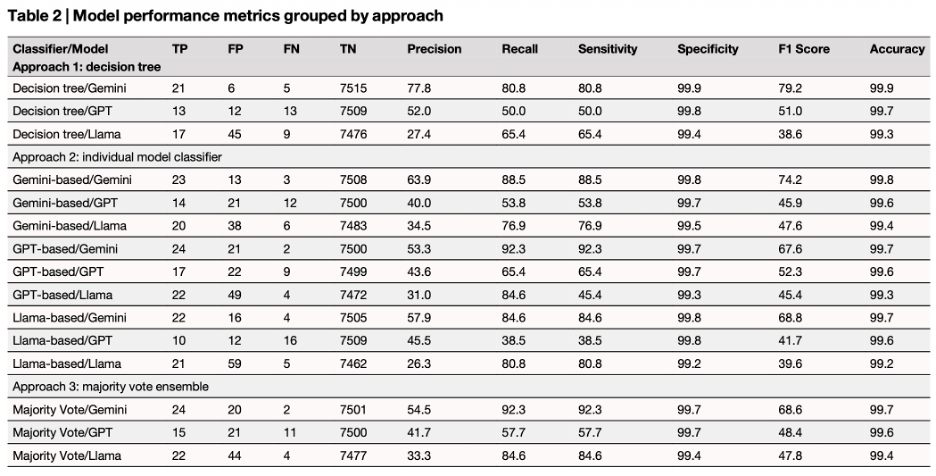
Table from TheraMind study: Model performance metrics across all three approaches (recall, specificity, F1).
The authors emphasize that the approach is transparent and auditable, with every classification traceable to specific clinical criteria. They also showed it extends beyond lung cancer, applying the framework to breast cancer candidates (and reporting when no supporting evidence actually existed).
Conclusion
The takeaway for oncologists: tools like TheraMind can meaningfully compress the timeline from computational drug discovery to clinical trial planning, while also helping clinicians find real-world signals instead of the time-consuming, manual PubMed searches for patients who have exhausted standard options.