
Improving Confidence With BCMA-Directed Therapies in Relapsed/Refractory Multiple Myeloma
Expert Perspectives · Lyn Brook · 2024-10-09
i3 Health recently provided an educational activity that has challenged clinicians’ knowledge proficiency pertaining to the topic of B-cell maturation antigen (BCMA)–directed therapies for improved patient outcomes in relapsed/refractory multiple myeloma (MM).
Multiple myeloma is a disease that remains incurable for most patients, many of whom become refractory to most available treatments. It is estimated that 35,780 new cases of multiple myeloma are diagnosed in the United States annually, and 12,540 people die of the disease. Agents targeting BCMA, including antibody-drug conjugates (ADCs), chimeric antigen receptor (CAR) T-cell therapies, and bispecific T-cell engagers, represent a promising therapy class for patients in need of additional treatment options, including those with higher genetic risk and heterogeneity. Therefore, it remains imperative that clinicians receive adequate up-to-date education on emerging BCMA-directed therapies for relapsed/refractory MM.
To address the knowledge gaps experienced by clinicians regarding relapsed/refractory MM, i3 Health curated a continuing medical education (CME)/nursing continuing professional development (NCPD)–accredited online video viewpoint strategy session. The activity was made available on i3 Health’s website starting on May 23, 2023, through May 22, 2024. Leading this activity was a key expert in the field of multiple myeloma, Rahul Banerjee, MD, FACP, Assistant Professor in the Division of Medical Oncology at the University of Washington, Fred Hutchinson Cancer Center.
Approximately six months following the activity’s recording, Dr. Banerjee sat down to discuss additional advancements in the treatment of relapsed/refractory multiple myeloma, with a focus on FDA approvals that have expanded since the activity was launched.
Between the enduring activity and the additional advancements, a total of 1,360 learners participated with the activity, and 354 completed the activity for credit. Most learners were physicians and registered nurses, followed by physician assistants, nurse practitioners, pharmacists, and those who chose “other” as their profession.
The baseline data collected revealed knowledge gaps in the following areas:
- Evaluating the mechanisms of action, efficacy, and safety of BCMA-directed therapies in relapsed/refractory MM
- Assessing guideline-recommended combination and sequential treatment strategies for relapsed/refractory MM
- Identifying risk factors for the development of treatment-specific adverse events with different classes of BCMA-directed therapies
- Describing mechanisms of drug resistance/loss of response to BCMA-directed therapies
- Examining the roles of gene expression profiling, soluble BCMA, and measurable residual disease (MRD) in clinical practice
Participants were given a matching pretest and posttest at the beginning and end of the activity, respectively:
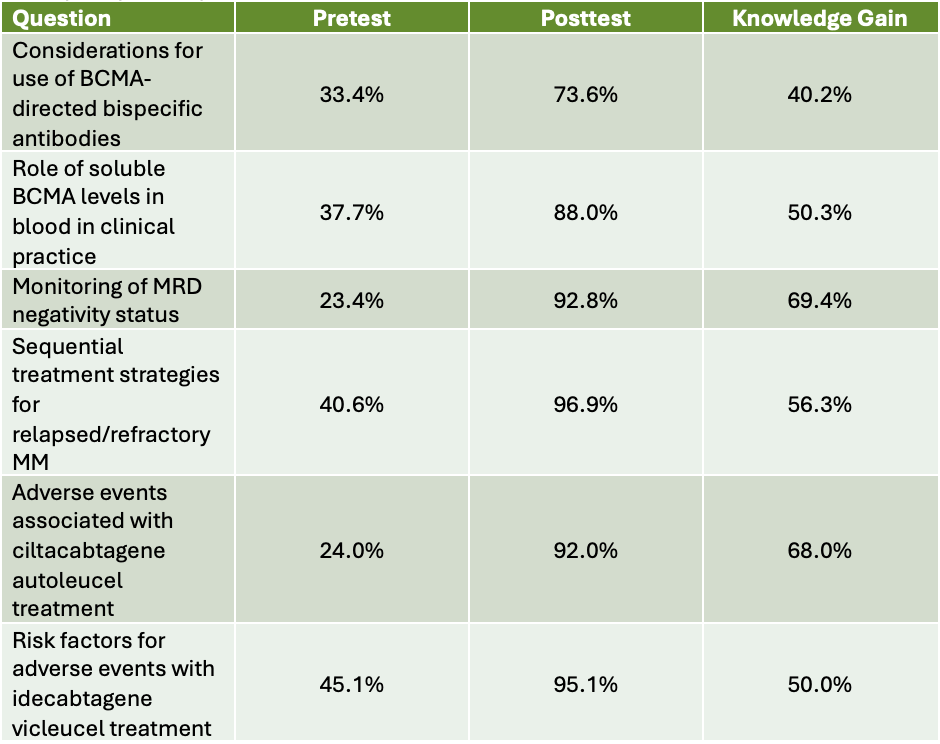
Upon completion of the activity, 86% of learners reported that they felt more confident in treating their patients with MM, and 93% felt the material presented would be used to improve the outcomes of their patients with MM.
The data revealed by the posttest assessment affirm the effectiveness of online educational content pertaining to the topic of relapsed/refractory MM. Based on these data, i3 Health has determined that clinicians, including hematology/oncology fellows, may benefit from CME activities that provide MM education on the following:
- Mechanisms of action, efficacy, and safety of BCMA-directed therapies
- Guideline-recommended combination and sequential treatment strategies
- Risk factors for treatment-specific adverse events with different classes of BCMA-directed therapies
- Mechanisms of drug resistance/loss of response to BCMA-directed therapies
- Roles of gene expression profiling, soluble BCMA, and MRD in clinical practice
Resources
i3 Health (2024). Leveraging BCMA-directed therapies for improved patient outcomes in relapsed/refractory multiple myeloma: outcomes activity report. Data on file.