
Improving Oncologic and Genetic Management of Von Hippel-Lindau Disease
Expert Perspectives · Lyn Brook · 2025-10-27
i3 Health recently provided an educational activity that challenged clinicians’ knowledge proficiency regarding the comprehensive oncologic and genetic management of von Hippel-Lindau (VHL) disease.
Gaps and Challenges
Von Hippel-Lindau disease is a rare genetic autosomal dominant syndrome caused by a germline mutation and/or deletion of the VHL gene that can predispose individuals to developing tumors and cysts in multiple organs. The prevalence of VHL is estimated to be between 1 in 30,000 to 1 in 50,000 people, impacting around 6,000 to 7,000 individuals in the United States. Von Hippel-Lindau disease can affect multiple organs, resulting in diverse symptoms that overlap with various conditions.
Because VHL disease is considered a rare disease, limited evidence is available for diagnosis, surveillance, active treatment with local or systemic therapy, and follow-up. Treatment options are based on the clinician’s evaluation of the patient’s symptoms, laboratory test results, and general physical condition as well as the location and size of the lesions. Repeated surgeries cause substantial morbidity and negatively affect quality of life. The heterogeneity and complexity of VHL disease manifestations, coupled with its chronic and progressive course, necessitate a multidisciplinary approach to the evaluation and management of patients. Thus, it is imperative that the multidisciplinary team participate in up-to-date educational activities on the management of VHL disease.
Addressing the Gaps
To address the knowledge gaps experienced by clinicians regarding the management of VHL disease, i3 Health hosted an online CME/NCPD/CE-approved play-at-home enduring webinar archive titled Comprehensive Management of Von Hippel-Lindau Disease: Genetic and Oncological Perspectives. Participants were able to choose between two dates to view the live webinar and presentation, either on June 26 or July 11, 2024. Following the live webinar, the activity was made available on i3 Health’s website beginning July 31, 2024, until July 30, 2025. Eric Jonasch, MD, Professor of Medicine at the University of Texas, MD Anderson Cancer Center, provided insightful genetic and oncological perspectives on evidence-based strategies to inform diagnosis, genetic testing techniques, and treatment of VHL disease with novel and emerging therapies.
A total of 2,199 individuals participated in the activity, with 656 completing it for credit. Most learners were nurses, followed by specialty physicians, nurse practitioners, primary care physicians, pharmacists, physician assistants, and those who chose “other” as their profession.
The baseline data collected revealed knowledge gaps in the following areas:
- Recognizing the diverse clinical presentations of VHL disease–associated tumors across different organ systems
- Discussing the capabilities and limitations of current genetic testing techniques for VHL disease
- Evaluating the latest evidence on novel and emerging therapies for VHL disease-associated tumors
- Applying expert strategies to clearly communicate complex genetic information to patients and family members during counseling sessions
Efficacy of the Education
Participants were given a matching pretest and posttest at the beginning and end of the activity, respectively:
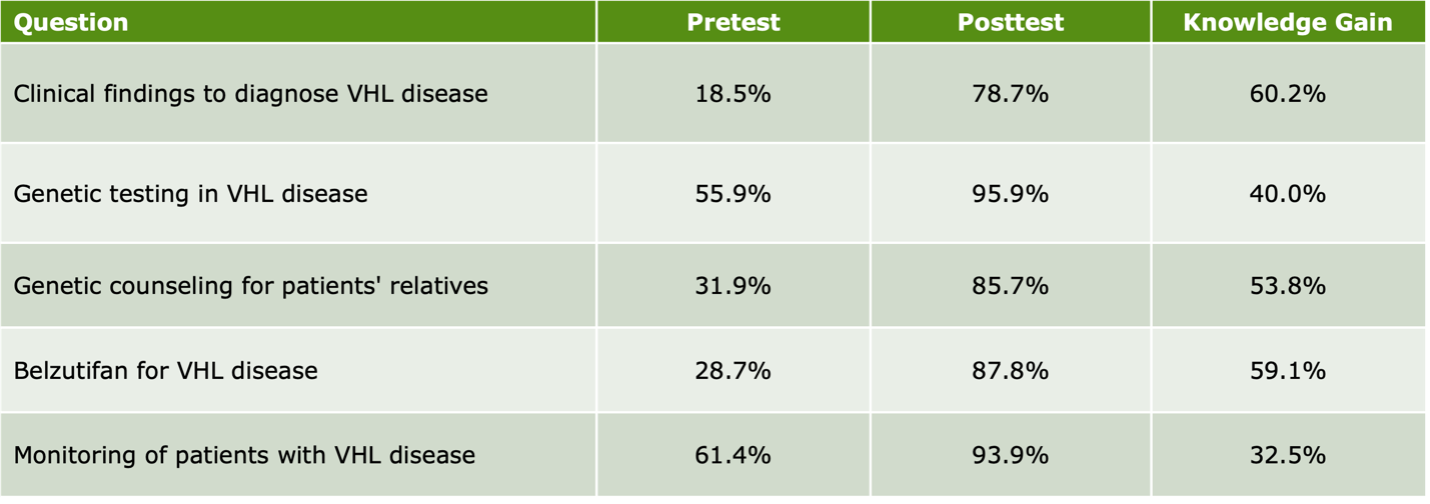
Upon completion of the activity, 85% of learners who completed the evaluation (N=637) felt more confident in treating their patients with VHL, and 83% of learners felt the material presented would be used to improve the outcomes of their patients.
Future Education
The data revealed by the posttest assessment affirm the effectiveness of online educational content pertaining to the comprehensive management of VHL disease. Based on these data, i3 Health has determined that the interprofessional team may benefit from CME/NCPD/CE activities that provide VHL disease education on:
- Diverse clinical presentations of VHL disease–associated tumors across different organ systems
- Capabilities and limitations of current genetic testing techniques
- Latest evidence of novel and emerging therapies
- Expert strategies to clearly communicate complex genetic information to patients and family members during counseling sessions
Resources
i3 Health (2025). Comprehensive management of von Hippel-Lindau disease: Genetic and oncological perspectives: activity outcomes report. Data on file.