
Making the Match: How AI Improves Clinical Trial Matching
Expert Perspectives · Waqas Haque · 2026-08-21
The rapid integration of artificial intelligence (AI) into oncology is redefining modern cancer care, and few areas hold as much immediate promise as clinical trial recruitment. Despite oncology research advancing at a historic pace and annual US cancer diagnoses projected to reach 2.3 million by 2030, the trial enrollment system remains severely bottlenecked—an estimated 40% of cancer trials fail to enroll a single patient, and only a small fraction hit recruitment targets on time. Bridging this critical gap requires transitioning past rigid, labor-intensive manual screening and moving toward intelligent, scalable solutions. In this edition of The Way Ahead, Waqas Haque, MD, MPH, explores how emerging AI platforms and natural language models are transforming clinical trial matching from an administrative obstacle into a streamlined, patient-centric gateway to life-saving therapies.
Gaps in Cancer Clinical Trial Matching
The last two years have been transformative years for AI applications in oncology. Dr. Doug Flora, Executive Medical Director of Oncology at St. Elizabeth Healthcare and Editor of ASCO Daily News, launched his popular blog with an analysis of the top 10 AI in oncology developments. The list was headlined by Demis Hassabis and the DeepMind team winning the Nobel Prize for their groundbreaking work with AlphaFold, marking the first Nobel recognition of AI's impact in medicine. At #3 on Dr. Flora's list was the revolution in clinical trial matching through AI, which is a domain historically plagued by inefficiency. Currently, 40% of cancer clinical trials fail to enroll a single patient, and only 3% to 5% meet their recruitment targets on time. These challenges persist despite projections showing that US cancer cases are expected to reach 2.3 million annually by 2030.
The Paradigm Shift
Beyond traditional academic publications, a new wave of physician thought leaders like Dr. Bishal Gyawali at Queen's University, Dr. Jeremy Warner at Vanderbilt, and Dr. Eric Topol at Scripps Research are actively shaping the AI/oncology discourse through their influential social media presence and Substacks—offering real-time analysis of emerging developments, critiquing AI models' clinical validity, and providing nuanced perspectives on how these technologies could transform cancer care delivery.
TrialGPT represents a paradigm shift in clinical trial matching, moving beyond traditional eligibility criteria matching systems to a more patient-centric approach. Unveiled in early 2023 through a collaboration between medical AI researchers and clinical oncologists, TrialGPT operates by allowing patients to describe their medical situation in everyday language, then generates an eligibility score along with detailed explanations for each trial criterion. In validation studies, the system demonstrated performance comparable to human clinical trial coordinators while reducing screening time by over 40%. This breakthrough sparked broader industry interest, exemplified by Dana-Farber Cancer Institute's partnership with Meta in October 2023 to develop an open-source platform using Llama 3 for analyzing unstructured clinical notes. These developments mark a fundamental shift in clinical trial matching, from a process historically dependent on manual screening and rigid inclusion/exclusion criteria to one that leverages AI to interpret patient contexts more naturally and efficiently.
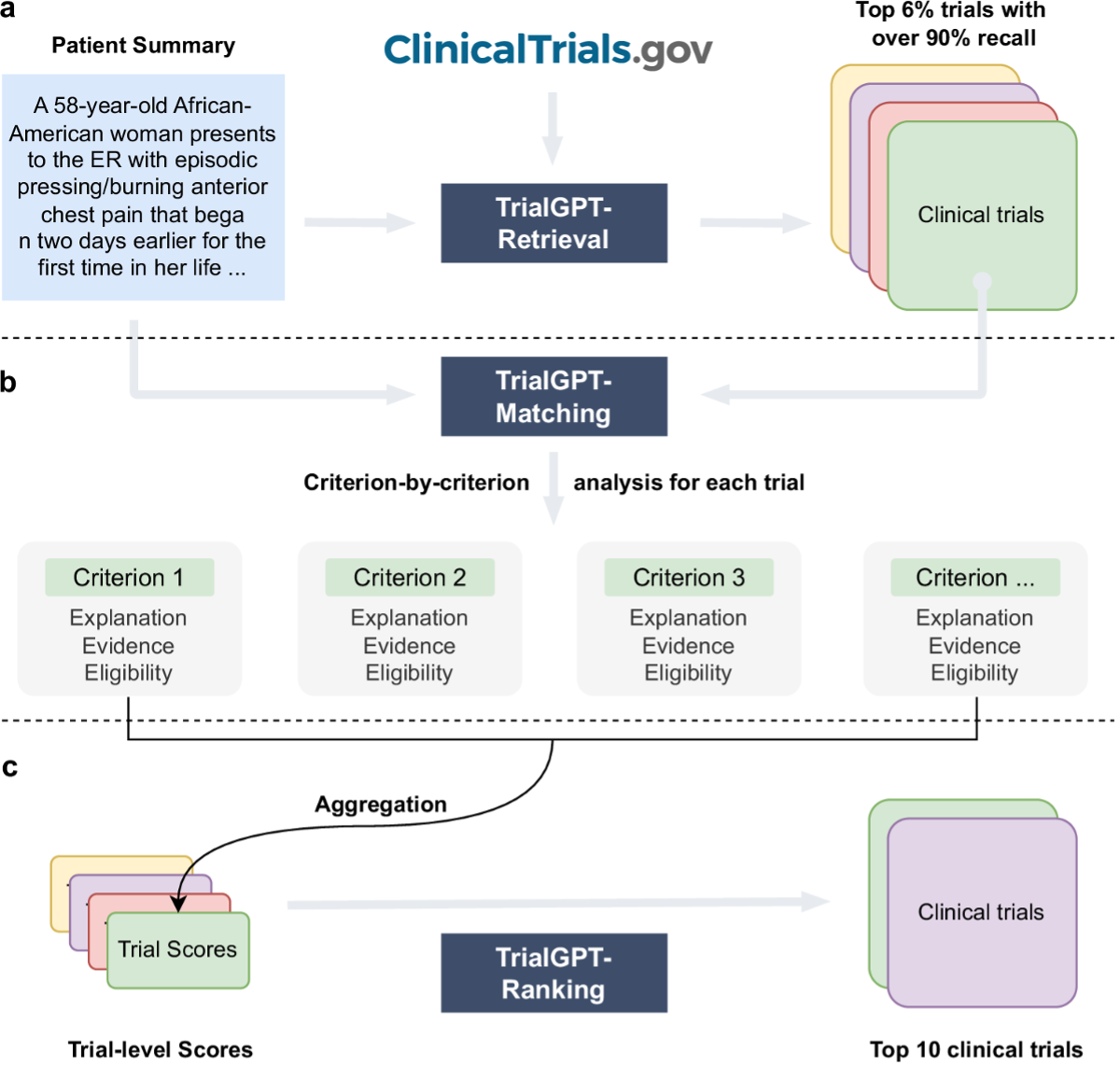
Schematic of the TrialGPT trial matching process
New Approaches to Trial Matching
The most effective AI trial matching systems employ a multi-layered approach that combines several AI technologies. At the foundation, natural language processing (NLP) engines interpret unstructured clinical notes and eligibility criteria, while knowledge graphs map complex relationships between medical concepts, conditions, and treatments. These are augmented by deep learning models, particularly transformer-based architectures like BERT, which have demonstrated over 85% accuracy in patient-trial matching.
The true power emerges when these technologies work in concert; for example, IBM's Watson combines NLP with rules-based systems to reduce screening time by 78%, while modern hybrid solutions simultaneously process structured data like lab values, apply semantic matching for medical terminology, and enforce explicit inclusion/exclusion rules. This multimodal approach enables the technology to mirror how human coordinators evaluate trial eligibility: understanding patient context, interpreting complex relationships, and applying specific trial criteria, all at a much larger scale and faster pace.
Progress With AI-Powered Methods
Recent studies demonstrate remarkable progress in AI-powered clinical trial matching. In a study of non–small cell lung cancer trials, GPT-3.5 achieved 95% accuracy in zero-shot scenarios and perfect accuracy with 80-case training when evaluated against human epidemiologists' assessments. Similarly, TrialGPT showed impressive performance across its three-module system. Its retrieval module successfully identified over 90% of relevant trials while examining less than 6% of the available trial pool, and its matching module achieved 87.3% accuracy in criterion-level eligibility assessment, approaching expert-level performance. The system demonstrated practical efficiency gains, reducing screening time by 42.6%.
A separate Stanford Medicine study developed a zero-shot LLM system that processes unstructured clinical notes, generating interpretable justifications that clinicians found coherent in 97% of correct decisions. These consistent results across multiple studies suggest AI systems are not only matching human-level accuracy but also delivering significant efficiency improvements in trial matching.
Several commercial and academic platforms illustrate this progress. Inspirata's Trial Navigator uses AI and NLP to match cancer patients to trials, achieving 90% accuracy in a retrospective study of biomarker- and tumor-directed trial matching. Trialjectory's AI platform analyzes patient questionnaire data to match clinical trials, demonstrating 90% sensitivity and 95% specificity, with a 99.9% trial match rate. An explainable AI system for phase I oncology trials achieved 73.68% precision and 89.36% specificity in matching patient records to trial protocols.
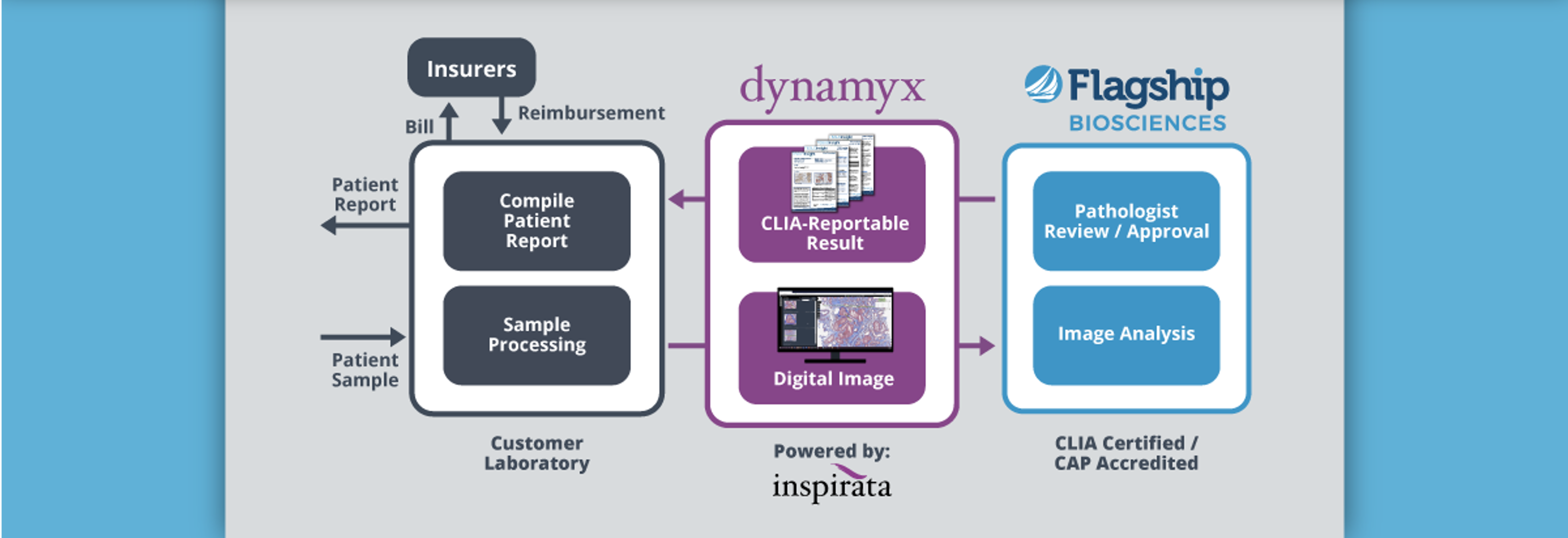
Diagram of Inspirata Trial Navigator
Conclusion
The convergence of AI and oncology trial matching represents one of the most promising developments in cancer care delivery. While early systems focused on basic eligibility matching, today's AI platforms like TrialGPT and Trial Navigator demonstrate near-human accuracy while significantly reducing screening time, suggesting a future where trial access becomes more democratic and efficient. As physician thought leaders like Dr. Flora and Dr. Gyawali continue to shape the discourse around AI's role in oncology, and as platforms consistently demonstrate 85% to 95% accuracy rates across different trial types, we're witnessing a fundamental transformation in how we connect patients with potentially life-saving clinical trials.
About Dr. Haque
Waqas Haque, MD, MPH, is a third-year Hematology/Oncology Fellow at the University of Chicago. He previously completed his Internal Medicine Residency at New York University (NYU) in a Clinical Investigator Track. Dr. Haque has balanced his patient care work with a variety of research projects. During his fellowship training at the University of Chicago, he plans to further his work in innovative clinical trial design, value-based care delivery to cancer patients, and clinical investigation.