
Multicancer Early Detection: Understanding the Science and Promoting Practical Application
Expert Perspectives · Lyn Brook · 2026-02-11
Gaps and Challenges
Cancer is a major health problem worldwide and is the second leading cause of death in the United States. Approximately 70% of all cancer deaths result from those without proven screening tests, and roughly 50% of cancers are detected only at an advanced stage, when treatment options are limited and prognosis is poor. Unfortunately, this pattern is more common than the exception across many cancer types that lack screening tests.
Despite evidence that screening and early detection have contributed to the steady decline in mortality from several types of cancers, many people are not getting screened in accordance with guidelines. In addition, numerous factors could affect cancer screening behavior and adherence, such as sociodemographic characteristics, screening cost, health insurance, education, age, income, proximity to screening sites, disease knowledge, patient and clinician attitudes, and availability of adequate health care facilities. Therefore, it is imperative that clinicians receive adequate and up-to-date education pertaining to this topic.
Addressing the Gaps
To address the knowledge gaps experienced by clinicians regarding MCED testing, i3 Health curated a three-module CME-approved video and podcast activity titled, Optimizing Cancer Screening With MCED Technologies: From Science to Practical Application. The activity was made available on i3 Health’s website beginning August 20, 2024, until August 19, 2025. Leading the activity was Charles Vega, MD, a Clinical Professor of Family Medicine, Director of the UC Irvine Program in Medical Education for the Latino Community (PRIME-LC), and Associate Dean for the School of Medicine at The University of California, Irvine.
A total of 19,583 learners participated, with 735 completing the activity for credit. Most learners were internal medicine physicians, primary care physicians, and nurses, followed by oncology/hematology physicians, gastroenterology physicians, obstetrics/gynecology physicians, physician assistants, nurse practitioners, other health professionals, and those who chose “other” as their profession.
The baseline data collected revealed knowledge gaps in the following areas:
Differentiating MCED tests from other blood-based screening tests
Explaining how MCED testing complements existing screening and diagnostic methods in gastrointestinal, gynecologic, and hematologic cancers
Assessing current and emerging data supporting the use of MCED tests in clinical practice
Discussing tactics to promote the widespread adoption of cancer screening in the community
Applying practical tools and strategies for integrating the latest cancer screening technologies into the clinical workflow
Efficacy of the Education
Participants were given a matching pretest and posttest at the beginning and end of the activity, respectively:
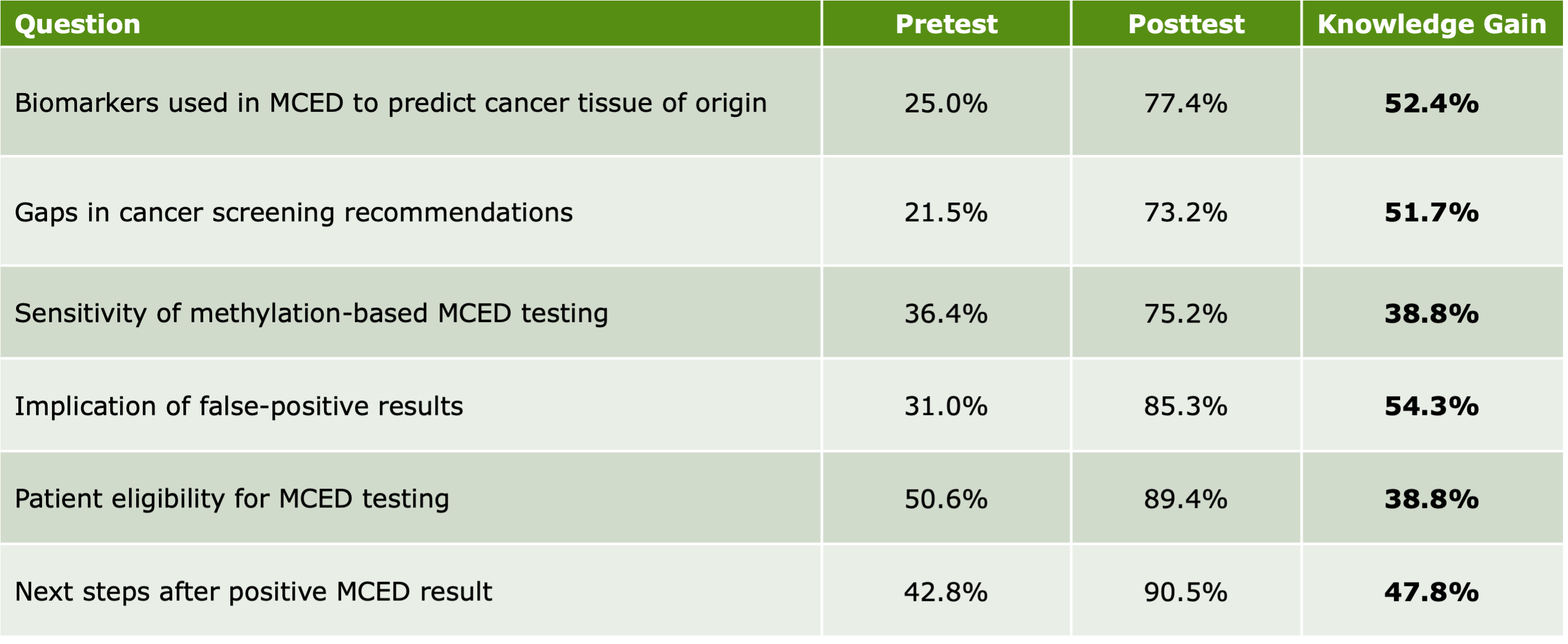
Upon completion of the activity, 87% of learners who completed the evaluation (N=721) reported they felt more confident in counseling their patients about MCED testing, and 86% felt the material presented would be used to improve the outcomes of their patients.
Future Education
The data revealed by the posttest assessment affirm the effectiveness of online educational content pertaining to the topic of MCED testing and technologies. Based on these data, i3 Health has determined that clinicians may benefit from CME activities that provide education on:
Differentiating MCED tests from other cancer screening tests
How MCED testing complements existing screening and diagnostic methods in gastrointestinal, gynecologic, and hematologic cancers
Assessing emerging data supporting the use of MCED tests in clinical practice
Tactics to promote the widespread adoption of cancer screening in the community
Applying practical tools and strategies for integrating the latest cancer screening technologies into the clinical workflow
Resources
i3 Health (2026). Optimizing cancer screening with MCED technologies:
From science to practical application: activity outcomes report. Data on file.