
Optimizing Clinical Strategies for Successful Stem Cell Mobilization Outcomes in Multiple Myeloma
CME · Lyn Brook · 2026-01-28
i3 Health recently provided an educational activity that challenged clinicians’ knowledge and proficiency regarding successful stem cell mobilization in multiple myeloma (MM).
Gaps and Challenges
Hematopoietic stem cell transplant (HSCT) is a potentially curative therapy for patients with hematologic malignancies such as MM. There are two primary types of HSCT: autologous, where the cells are taken from the patient; and allogeneic, where the cells come from a matched sibling donor or an unrelated donor. Despite the advancements in drug therapies, autologous HSCT (ASCT) continues to be a critical component of standard treatment for both newly diagnosed and relapsed MM, especially for younger patients without significant comorbidities. However, only 20% to 30% of patients for whom ASCT is indicated undergo the procedure. Studies show that the use of HSCT remains suboptimal, placing many patients at increased risk for poor survival outcomes. Although widely accepted as a standard practice, ASCT is still challenged by inevitable relapses threatening long-term remissions. As a result, some myeloma experts choose to delay ASCT until there is evidence of relapse or disease progression. Moreover, the collection of adequate hematopoietic stem cell (HSC) yield is critical to a successful ASCT but not always achieved due to the HSC mobilization failure. The optimal stem cell mobilization strategy remains a matter of debate. Thus, it is imperative that clinicians receive adequate and up-to-date education pertaining to this topic.
Addressing the Gaps
To address the knowledge gaps experienced by clinicians regarding stem cell mobilization strategies for ASCT for patients with MM, i3 Health curated the online CME/NCPD/AAPA-approved enduring activity titled, Cracking the Code to Successful Stem Cell Mobilization in Multiple Myeloma. The activity was made available on i3 Health’s website beginning October 8, 2024, until October 7, 2025. Leading the activity was Hamza Hashmi, MD, an Assistant Attending in the Myeloma and Cell Therapy Service at Memorial Sloan Kettering Cancer Center.
A total of 5,263 learners participated in the activity, with 657 completing it for credit. Most learners were nurses, followed by physicians, physician assistants, nurse practitioners, pharmacists, and those who chose “other” as their profession.
The baseline data collected revealed knowledge gaps in the following areas:
Evaluating current and emerging data on stem cell mobilization regimens in patients with MM
Identifying patients eligible for ASCT and at high risk of mobilization failure
Applying interdisciplinary strategies to mitigate poor mobilization and optimize ASCT outcomes
Efficacy of the Education
Participants were given a matching pretest and posttest at the beginning and end of the activity, respectively:
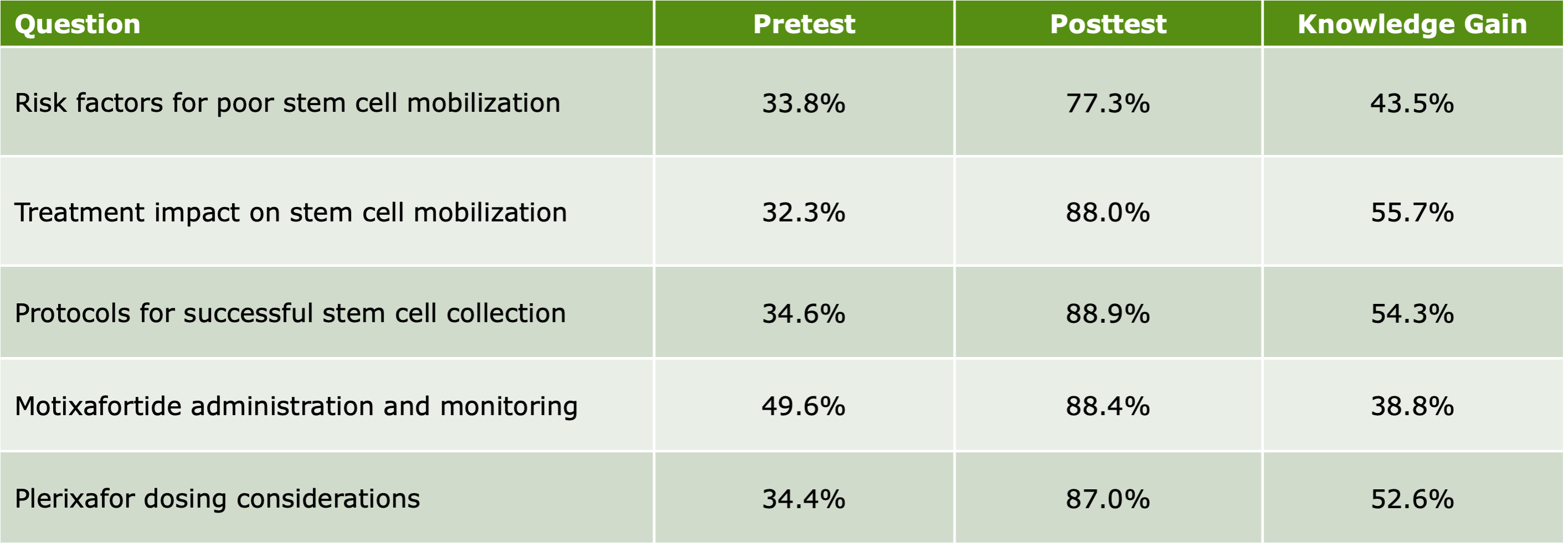
Upon completion of the activity, 91% of learners who completed the evaluation (N=654) reported that they felt more confident in managing patients with MM, and 91% felt the material presented would be used to improve the outcomes of their patients.
Future Education
The data revealed by the posttest assessment affirm the effectiveness of online educational content pertaining to the topic of MM treatment and management via ASCT. Based on these data, i3 Health has determined that clinicians may benefit from CME/NCPD/AAPA activities that provide education on:
Evaluating current and emerging data on stem cell mobilization regimens in patients with MM
Identifying patients eligible for ASCT and at high risk of mobilization failure
Applying interdisciplinary strategies to mitigate poor mobilization and optimize ASCT outcomes
Resources
i3 Health (2026). Cracking the code to successful stem cell mobilization in multiple myeloma: activity outcomes report. Data on file.