
Tailoring Diagnostic and Treatment Strategies in Systemic Mastocytosis
CME · Lyn Brook · 2026-07-13
i3 Health recently provided an educational activity that challenged clinicians’ knowledge and proficiency regarding early detection and tailored treatment strategies for systemic mastocytosis (SM).
Gaps and Challenges
Systemic mastocytosis (SM) is a rare, heterogeneous group of diseases characterized by an abnormal proliferation and accumulation of clonal mast cells in various organs, including the skin, bone marrow, spleen, liver, and gastrointestinal tract. The estimated incidence of SM is 1 per 100,000 individuals. The five-year relative survival of patients with SM is 74%, but this varies widely depending on subtype. Patients with SM have a higher risk of developing both solid organ and hematologic malignancy within five years of diagnosis, further complicating management. Diagnosing SM is particularly challenging due to its varied presentation, requiring high clinical competence. Any delay in the diagnostic process can result in serious complications, including organ dysfunction and life-threatening anaphylaxis. Despite improved understanding of the disease and treatment advances, substantial gaps persist in diagnosis, access to specialized care, symptom management, and treatment efficacy. These gaps underscore the need for increased disease awareness among healthcare providers and interprofessional coordination to optimize patient care. Due to this, it is imperative clinicians receive adequate educational opportunities to increase their mastery of treating and managing SM.
Addressing the Gaps
To address the knowledge gaps experienced by clinicians regarding management and treatment strategies for SM, i3 Health curated the CME/AAPA/NCPD-accredited enduring activity titled, Mastering Systemic Mastocytosis: From Early Detection to Tailored Treatment Strategies. The activity was made available as part of a two-module series on i3 Health’s website beginning April 16, 2025, until April 15, 2026. Both video and podcast versions of the material were made available for learners to choose their preferred method of engagement. Leading the activity was Mariana Castells, MD, PhD, Director of the Mastocytosis Center at Brigham and Woman's Hospital, and Professor of Medicine at Harvard Medical School.
A total of 5,930 learners participated in the activity, with 1,049 completing it for credit. Most learners were nurses, followed by physicians, physician assistants, nurse practitioners, and those who chose “other” as their profession.
The baseline data collected revealed knowledge gaps in the following areas:
Recognizing the diverse clinical manifestations of SM for prompt diagnosis and treatment initiation
Assessing the clinical evidence for novel therapies in SM, evaluating their potential to improve patient outcomes
Developing personalized treatment plans, integrating expert strategies on treatment selection and adverse event management
Efficacy of the Education
Participants were given a matching pretest and posttest at the beginning and end of the activity, respectively:
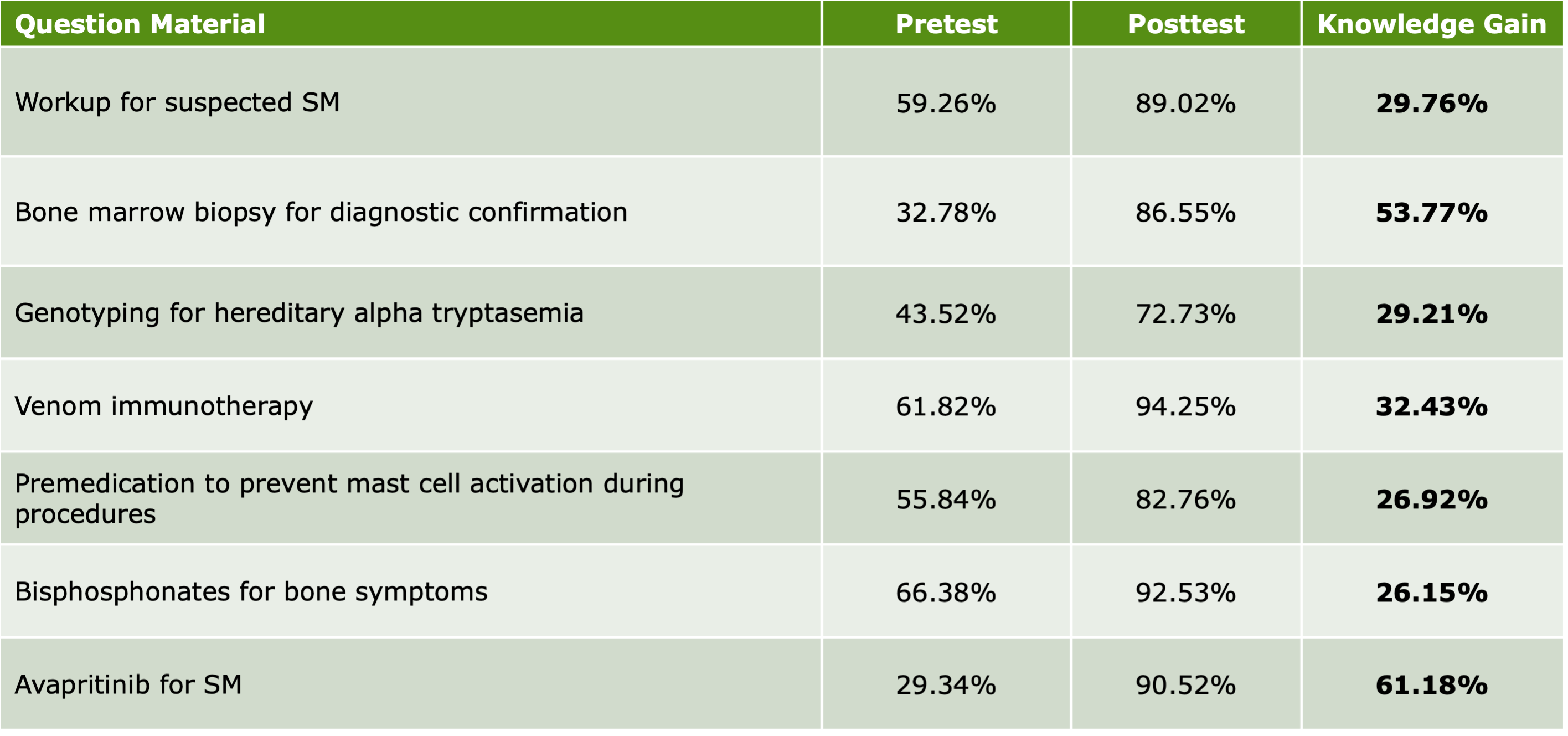
Upon completion of the activity, 88% of learners who completed the evaluation (N=1,054) reported that they felt more confident in treating patients with SM, and 87% felt the material presented would be used to improve the outcomes of their patients.
Future Education
The data revealed by the posttest assessment affirm the effectiveness of online educational content on treating and managing SM. Based on these data, i3 Health has determined that clinicians may benefit from CME/AAPA/NCPD activities that provide education on:
Recognizing the diverse clinical manifestations of SM for prompt diagnosis and treatment initiation
Assessing the clinical evidence for novel therapies in SM, evaluating their potential to improve patient outcomes
Developing personalized treatment plans, integrating expert strategies on treatment selection and adverse event management
Resources
i3 Health (2026). Mastering systemic mastocytosis: from early detection to tailored treatment strategies. Activity outcomes report. Data on file.