
Tailoring Treatment and Building Confidence in Management of Hemophilia
Expert Perspectives · Lyn Brook · 2025-08-29
i3 Health recently provided an educational activity that challenged clinicians’ knowledge proficiency regarding practice-changing advancements in the management and treatment of hemophilia.
Gaps and Challenges
Hemophilia is an inherited bleeding disorder in which the blood does not clot properly, causing affected individuals to experience spontaneous bleeding as well as bleeding after injuries or surgery. The two most common types are hemophilia A, caused by low levels of clotting factor VIII; and hemophilia B, caused by low levels of clotting factor IX. The standard treatment for hemophilia involves replacing the missing blood clotting factor by infusing commercially prepared factor concentrates. However, approximately 15% to 20% of patients will develop an inhibitor, an antibody that prevents the clotting factor from working, resulting in increased complications and the need for more complex management. It is vital that clinicians remain up to date on the latest data on novel and emerging therapies for hemophilia A and B in order to provide the most tailored treatment options to their patients.
Addressing the Gaps
To address the knowledge gaps experienced by clinicians regarding the treatment of hemophilia, i3 Health provided an online CME/NCPD activity titled Practice-Changing Advances in the Management of Hemophilia. The activity was made available starting June 21, 2024, until June 20, 2025. Leading the activity were Guy Young, MD,
Director of the Hemostasis and Thrombosis Program, Attending Physician of Hematology-Oncology, and Professor of Pediatrics at the Keck School of Medicine of the University of Southern California (USC); and Jennifer Davila, MD, Co-Director of the Hemophilia Treatment Center at Montefiore and Associate Professor of Pediatrics at The Children’s Hospital at Montefiore.
A total of 3,254 learners participated in the online material, with 519 completing the activity for CME/NCPD credit. Most learners were physicians and registered nurses, followed by physician assistants, advanced practice nurses, nurse practitioners, pharmacists, and those who chose “other” as their profession.
The baseline data collected revealed knowledge gaps in the following areas:
- Appraising the mechanisms of action, efficacy, safety, and indications of novel and emerging therapies for hemophilia A and B
- Evaluating strategies to tailor treatment to individual patients with hemophilia
- Assessing approaches to address the problem of nonadherence to hemophilia treatment
Efficacy of the Education
Participants were given a matching pretest and posttest at the beginning and end of the activity, respectively:
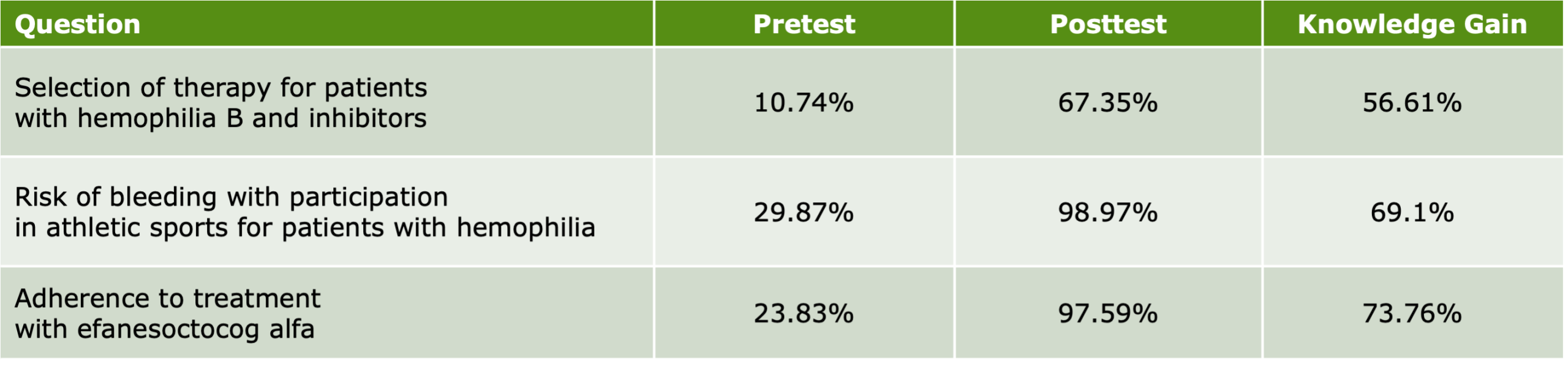
Upon completion of the activity, 86% of learners who completed the evaluation (N=502) felt more confident in treating their patients with hemophilia, and 85% of learners felt the material presented would be used to improve the outcomes of their patients.
Future Education
The data revealed by the posttest assessment affirm the effectiveness of online educational content pertaining to hemophilia management. Based on these data, i3 Health has determined that the interprofessional team may benefit from CME and NCPD activities that provide education on hemophilia.
Resources
i3 Health (2025). Practice-changing advances in the management of hemophilia: activity outcomes report. Data on file.