
Theranostics in Prostate Cancer: Transforming Treatment With Precision Medicine
Expert Perspectives · Waqas Haque, MD, MPH · 2025-04-16
Theranostics—an approach that combines diagnostic imaging and therapy, using the same molecular target—is revolutionizing the field of oncology, offering a groundbreaking approach to precision medicine that brings new hope to patients with advanced cancers. In this edition of The Way Ahead: The Convergence of Technology and Cancer Care, Dr. Waqas Haque, Hematology/Oncology Fellow at the University of Chicago, delves into the transformative potential of theranostics, with a focus on lutetium Lu-177 vipivotide tetraxetan (Pluvicto®) for metastatic castration-resistant prostate cancer (mCRPC). From its innovative mechanism of action to pivotal clinical trials and the expanding role of PSMA PET imaging, Dr. Haque explores how theranostics is reshaping the standard of care and paving the way for a new era in personalized oncology.
Theranostics and the Evolving Landscape
If a patient with metastatic prostate cancer comes into the clinic having progressed after surgery, radiation, and multiple types of androgen deprivation therapies, chemotherapy (with docetaxel or cabazitaxel) has generally been one of the preferred later-line options for many years. Now, there’s a new option. In the ever-evolving landscape of oncology, theranostics represents one of the most promising advances for a precision medicine approach to patient care.
This approach combines diagnostic imaging and therapy, using the same molecular target, offering a truly personalized treatment strategy based on the exact location of the tumor. Nowhere is this more evident than in the management of metastatic castration-resistant prostate cancer (mCRPC) with the FDA-approved radiopharmaceutical lutetium Lu 177 vipivotide tetraxetan (Pluvicto®), which just received an expanded indication for mCRPC in chemotherapy-naïve patients at the end of March 2025.
How It Works
Lutetium-177 PSMA, formerly PSMA-617, is a radioligand therapy that specifically targets prostate-specific membrane antigen (PSMA), a protein highly expressed on the surface of prostate cancer cells. This therapy delivers targeted radiation to cancer cells while minimizing damage to surrounding healthy tissue.
In the landscape of radio-isotopes, lutetium-177 PSMA is one of nearly a dozen beta-emitters in clinical use, with an expanding number of radiopharmaceuticals being used for non-oncology indications in cardiology and neurology. The brilliance of this approach lies in its dual function: the same molecular target used to identify cancer cells becomes the pathway for delivering treatment. The main toxicities with this treatment include penetration into bone marrow (leading to an increased risk for cytopenias and secondary cancers) and dry mouth, given PSMA expression in salivary glands.
The Power of PSMA PET Scans
Central to the theranostic approach is the PSMA PET scan, which has revolutionized prostate cancer imaging. Unlike conventional imaging, PSMA PET scans use radiotracers that bind specifically to PSMA proteins on prostate cancer cells. This allows for:
- Detection of small metastases that would be missed by conventional imaging
- More accurate staging of disease
- Better selection of patients who would benefit from PSMA-targeted therapy
- Monitoring treatment response with unprecedented precision
The high sensitivity and specificity of PSMA PET have made it the gold standard for identifying patients suitable for lutetium-177 PSMA vipivotide tetraxetan therapy.
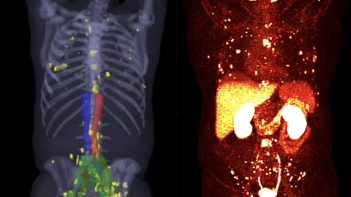
Two examples of PSMA-PET scans showing numerous prostate cancer metastases. Source: http://healthimaging.com/topics/medical-imaging/molecular-imaging/psma-pet-rapidly-changing-standard-care-prostate-cancer
Pivotal Trials
Several pivotal clinical trials have established lutetium-177 PSMA’s place in prostate cancer treatment:
- VISION trial: This phase 3 trial evaluated lutetium-177 PSMA plus standard of care (SOC) versus SOC alone in patients with PSMA-positive mCRPC who had progressed after chemotherapy and androgen receptor pathway inhibitors. Results showed significant improvements in both radiographic progression-free survival (8.7 vs 3.4 months) and overall survival (15.3 vs. 11.3 months), leading to FDA approval in March 2022 in patients who had progressed after chemotherapy. The trial was criticized for a substandard control arm and high attrition rate in the control arm
- TheraP trial: This Australian phase 2 trial compared lutetium-177 PSMA to cabazitaxel chemotherapy in mCRPC patients who had progressed after docetaxel. Lutetium-177 PSMA demonstrated superior prostate-specific antigen (PSA) response rates (66% vs 37%) and progression-free survival with fewer grade 3-4 adverse events, highlighting its efficacy and improved safety profile. Despite positive surrogate markers indicating lutetium-177 PSMA’s benefit, radiologic PFS did translate into an overall survival benefit
- PSMAfore trial: This more recent phase 3 trial investigated l lutetium-177 PSMA in earlier disease settings, specifically in patients who had not yet received chemotherapy. The trial demonstrated significant progression-free survival benefits, potentially expanding its use to earlier treatment lines. The difficulty in interpreting the survival curves in this trial is that patients who progressed on the control arm were allowed to cross-over to the lutetium-177 PSMA arm; during longer-term follow up, it is unclear if survival benefit is coming from lutetium-177 PSMA or from twice forgoing chemotherapy before finally starting it
The Future of Theranostics
The success of lutetium-177 PSMA represents just the beginning of theranostics in oncology, potentially tripling the number of eligible patients for the therapy in a disease where half of men do not live past second-line therapy in the metastatic setting. Ongoing research is exploring combinations with immunotherapy, optimal sequencing with other treatments, and applications in earlier disease stages.
Theranostics epitomizes the promise of precision medicine—delivering the right treatment to the right patient at the right time. For patients with advanced prostate cancer, this innovative approach offers new hope with better outcomes and quality of life.
About Dr. Haque
Waqas Haque, MD, MPH, is a Hematology/Oncology Fellow at the University of Chicago. He recently completed his Internal Medicine Residency at New York University (NYU) in a Clinical Investigator Track. Dr. Haque has balanced his patient care work with a variety of research projects. During his fellowship training at the University of Chicago, he plans to further his work in innovative clinical trial design, value-based care delivery to cancer patients, and clinical investigation.