
Revolutionizing Melanoma Treatment: The Technological Breakthrough of Tumor-Infiltrating Lymphocyte Therapy
Expert Perspectives · Waqas Haque, MD, MPH · 2025-03-06
Cutting-edge cell-based therapies are transforming the landscape of cancer treatment, offering new hope for patients with advanced disease. One such breakthrough is tumor-infiltrating lymphocyte (TIL) therapy, a novel approach leveraging technological advancements in cellular expansion and immunotherapy to harness a patient’s own immune system against melanoma. In this edition of The Way Ahead: The Convergence of Technology and Cancer Care, Dr. Waqas Haque, Hematology/Oncology Fellow at the University of Chicago, explores the latest developments in TIL therapy, its impact on treatment-resistant melanoma, and how emerging biotechnologies are shaping the future of personalized cancer care.
Melanoma Treatment: The Evolving Landscape
Recent advances in melanoma treatment have fundamentally transformed patient outcomes, with immune checkpoint inhibitors leading the way over the past decade. The approvals of antiprogrammed cell death protein 1 (PD-1) antibodies pembrolizumab and nivolumab, along with the CTLA-4 inhibitor ipilimumab, have established immunotherapy as a cornerstone of melanoma care, and we have seen the expansion of immunotherapy into numerous other tumor types.
Tumor-Infiltrating Lymphocytes: A Therapeutic Breakthrough
Building on this immunotherapeutic foundation, TIL therapy has emerged as a promising approach, particularly for patients who have progressed on checkpoint inhibition. The recent FDA approval of lifileucel last February represents a significant milestone, offering a personalized cellular therapy option with demonstrated efficacy in heavily pretreated patients. The ability of TIL therapy to harness a patient’s own tumor-specific T cells complements existing immunotherapeutic strategies. This is additionally exciting due to the relative paucity of advanced cellular therapies for solid tumors relative to blood cancers.
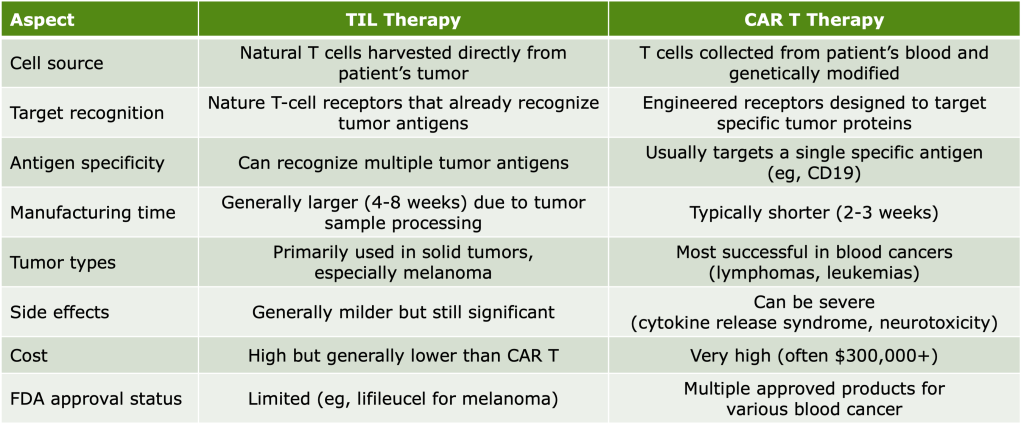
The use of TIL therapy in melanoma involves harvesting tumor-resident T cells, particularly CD8+ T cells, from resected tumor tissue and expanding them ex vivo in the presence of interleukin-2 (IL-2) to generate large numbers of tumor-reactive lymphocytes. Prior to TIL infusion, patients undergo lymphodepletion with cyclophosphamide and fludarabine to eliminate regulatory T cells and create an immunologically favorable environment by increasing the availability of homeostatic cytokines like IL-7 and IL-15.
The expanded TILs, which are enriched for tumor-specific T cell receptors through their original tumor residence, are then reinfused along with multiple doses of high-dose IL-2 to support their survival and function. These TILs can recognize multiple tumor neoantigens, offering broader coverage against tumor heterogeneity compared to engineered T cell approaches. Upon reinfusion, the TILs can mediate tumor cell killing through direct cytotoxicity and inflammatory cytokine production.
Evaluating the Efficacy of TIL Therapy
Table 1: Comparing TIL Therapy to CAR-T
 Several studies have evaluated the efficacy and safety of TIL therapy. A phase 2 study by Sarnaik et al evaluated lifileucel, an autologous TIL product, in patients with metastatic melanoma. The study reported an objective response rate (ORR) of 36%, with 2 complete responses and 22 partial responses. The disease control rate was 80%, and the median duration of response was not reached after a median follow-up of 18.7 months.
Another significant study by Rohaan et al, published in the New England Journal of Medicine in 2022, compared TIL therapy to ipilimumab in patients with advanced melanoma. The study demonstrated a significant benefit of TIL therapy over ipilimumab in terms of progression-free survival (PFS). The percentage of patients with an objective response was 49% in the TIL group compared to 21% in the ipilimumab group.
Figure 1: Progression-Free Survival With TIL vs Ipililumab in Rohaan et al (NEJM, 2022)
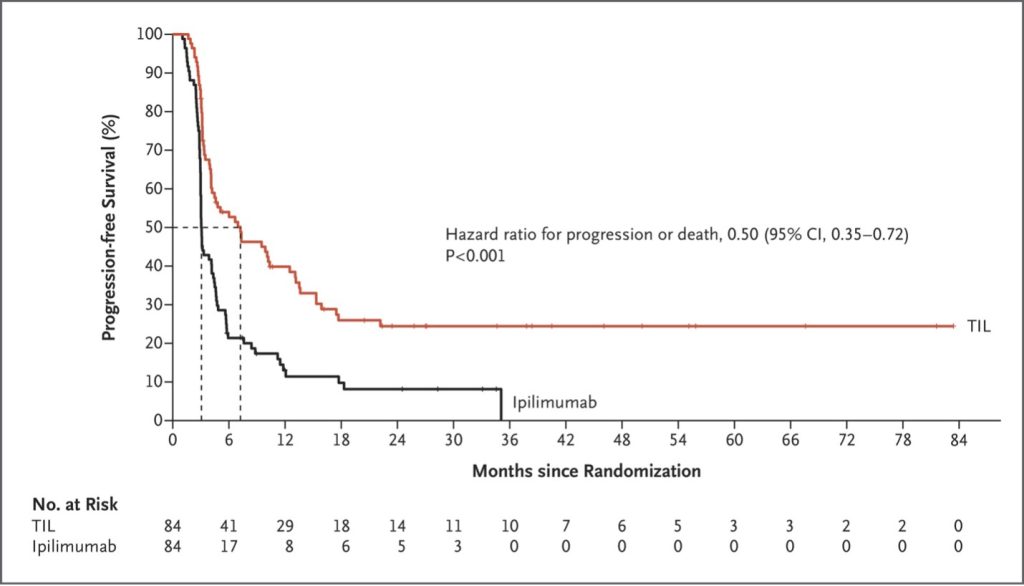
These studies highlight that TIL therapy can be particularly beneficial for heavily pretreated patients with advanced melanoma, including those with high disease burden and those who have failed multiple lines of prior therapy. The durable responses and manageable safety profile make TIL therapy a viable option for this challenging patient population.
Another reassuring aspect of this treatment is that the safety profile was consistent with known adverse events associated with nonmyeloablative lymphodepletion and IL-2 in Rohaan et al. At the same time, providers must be aware of common side effects including febrile neutropenia, low blood counts, and elevated liver enzymes. This raises the importance of patient selection and optimization programs before proceeding with such therapies.
Conclusion
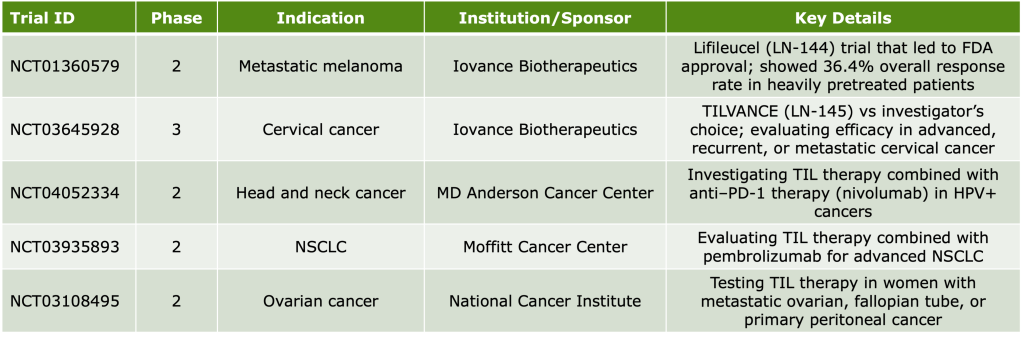
In summary, TIL therapy, has demonstrated durable responses and significant clinical benefit in patients with advanced melanoma, especially those refractory to prior treatments. Combination therapies are being tested with TIL therapy in clinical trials, and the therapy is being expanded beyond melanoma (Figure 2). The therapy is associated with a manageable safety profile, making it a viable option for patients with limited treatment alternatives.
Table 2: Notable Clinical Trials in the TIL Therapy Space
About Dr. Haque
Waqas Haque, MD, MPH, is a Hematology/Oncology Fellow at the University of Chicago. He recently completed his Internal Medicine Residency at New York University (NYU) in a Clinical Investigator Track. Dr. Haque has balanced his patient care work with a variety of research projects. During his fellowship training at the University of Chicago, he plans to further his work in innovative clinical trial design, value-based care delivery to cancer patients, and clinical investigation.